
Sham valley
3,510 meters
All season
3hrs
Lamayuru Monastery: History, Sacred Art and the Moonland of Ladakh
Discover the ancient traditions, surviving paintings, Naropa's meditation cave, Drikung Kagyu heritage and dramatic landscape of one of Ladakh's oldest and most spiritually important monasteries.
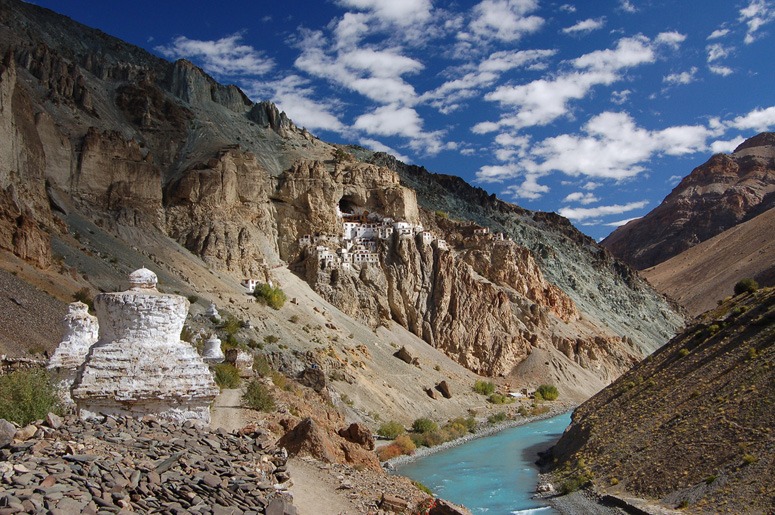
Lamayuru Monastery rises above a deeply eroded valley approximately 115 to 125 kilometres west of Leh. Surrounded by pale cliffs, ravines and unusual geological formations, the monastery appears to grow directly from the mountain. Its spectacular location, ancient temples and continuing religious traditions make Lamayuru one of the most remarkable cultural sites in Ladakh.
Known locally as Yuru Gonpa or Yungdrung Tharpaling, Lamayuru is closely associated with the Indian Buddhist master Naropa, the translator Rinchen Zangpo and the Drikung Kagyu school of Tibetan Buddhism.
Lamayuru is not simply an old building preserved for visitors. It remains an active monastery where monks study Buddhist philosophy, conduct prayers, perform ceremonies and preserve a religious lineage transmitted through generations.
Why Lamayuru Is So Important
Lamayuru occupies an important place in the religious and cultural history of western Ladakh. It is frequently described as one of the oldest surviving monastic establishments in the region and serves as an important centre of the Drikung Kagyu tradition.
Its importance comes from several layers of history. The site is associated with early Buddhist meditation, the great translation movement of the 10th and 11th centuries, later Drikung Kagyu masters, Ladakhi royal patronage and a living community of monks and local worshippers.
The monastery's official administration states that Lamayuru provides spiritual guidance to more than fifty affiliated monasteries in Lower Ladakh and that hundreds of monks are registered under its wider monastic administration.
Important distinction: Lamayuru is internationally significant, but it is not presently inscribed as a UNESCO World Heritage Site. It should therefore be described as an important Himalayan heritage monument rather than as a UNESCO-listed monastery.
The Meaning of Lamayuru's Traditional Name
Lamayuru is traditionally known as Yungdrung Tharpaling. Interpretations vary, but the name is commonly understood in relation to the idea of an eternal sacred symbol and a place of spiritual liberation.
The term yungdrung refers to the ancient swastika-shaped symbol used across Himalayan religious traditions as a sign of continuity, stability and eternity. In its original Asian religious context, this is an ancient sacred symbol entirely separate from its later misuse in twentieth-century Europe.
Tharpaling may be understood as a place of freedom or liberation. Lamayuru consequently became known through tradition as a protected place where spiritual practice, sanctuary and freedom were respected.
Lamayuru Before the Present Monastery
Local and monastic traditions maintain that the area had religious importance before the establishment of the present Buddhist monastery. Some accounts connect the site with the ancient Bon tradition that existed across the Tibetan plateau and Himalayan regions before Tibetan Buddhism became dominant.
Because Lamayuru's earliest history was preserved largely through monastic chronicles and oral tradition, it is difficult to assign exact dates to every stage of its development. The site's history should therefore be understood through both sacred tradition and surviving historical evidence.
The Legend of the Ancient Lake
Naropa and the Drying of the Lake
According to Lamayuru's best-known sacred legend, the valley was once covered by a large lake. The Indian Buddhist master Naropa is said to have visited the area during the 10th or 11th century and recognised it as a place suitable for spiritual practice.
Tradition says that Naropa caused the lake to drain or recede. After the water disappeared, a sacred landscape emerged and Lamayuru was established as a place of meditation.
The legend belongs to the monastery's religious history and should not be read as a modern scientific account. Geological research does, however, indicate that the Lamayuru valley contains substantial ancient lake sediments. This gives the traditional story an especially interesting relationship with the physical landscape.
The Moonland Landscape
The pale yellow, beige and grey formations surrounding Lamayuru are popularly known as the Moonland of Ladakh. Deep erosion has carved the soft sediment into ridges, fluted cliffs, gullies and pointed formations that appear especially dramatic in morning and evening light.
These formations are not the surface of the moon, but deposits connected with an ancient lake environment. Over long periods, wind, water, freezing and thawing shaped the exposed sediment into the unusual terrain visible today.
The monastery stands above this landscape on a rocky elevation, while the village occupies the slopes and cultivated ground below. Together, the monastery, village and eroded valley form one of Ladakh's most recognisable cultural landscapes.
Naropa and Lamayuru
Naropa, generally dated to approximately 956–1041 CE, was one of the most important Indian Buddhist masters associated with the transmission of Vajrayana Buddhism from India to Tibet.
He was a renowned scholar connected with Nalanda and later became a celebrated tantric practitioner. His teachings were transmitted through Marpa the Translator and became foundational to the Kagyu traditions of Tibetan Buddhism.
Lamayuru preserves a cave traditionally identified as Naropa's meditation cave. The cave is incorporated within the religious complex and remains one of the monastery's most sacred historical features.
The presence of the cave reflects an earlier phase of Himalayan Buddhism when yogis and travelling masters often meditated in natural shelters before large institutional monasteries developed around those sacred places.
Rinchen Zangpo and the Early Temple
Lamayuru is also connected with Lotsawa Rinchen Zangpo, the Great Translator, who lived from 958 to 1055 CE.
Rinchen Zangpo played a central role in the revival of Buddhism across the western Himalayas. Supported by the rulers of the western Tibetan kingdom, he travelled to centres of Buddhist learning, translated Sanskrit texts and helped establish temples throughout regions that now include Ladakh, Spiti and western Tibet.
Lamayuru's oldest surviving temple is traditionally identified as the Sengge Lhakhang, or Lion Temple. Its foundation is attributed to the period of Rinchen Zangpo and the great temple-building movement of the 10th and 11th centuries.
Historical descriptions state that the early complex once contained five principal buildings: one central temple and four structures arranged toward the surrounding directions. Only part of that early architectural arrangement survives today.
Documented History and Sacred Tradition
Early Sacred Landscape
The area may have had ritual importance before the construction of the surviving Buddhist monastery. Traditions connect it with early meditation and possibly with pre-Buddhist Bon practice.
10th–11th Century: Naropa
The site became closely associated with Naropa, whose meditation cave remains preserved within the monastery.
11th Century: Rinchen Zangpo Period
The earliest surviving temple is traditionally connected with Rinchen Zangpo and the Buddhist cultural revival of the western Himalayas.
Later Medieval Period
Lamayuru expanded through the patronage of religious teachers, local communities and Ladakhi rulers. Additional temples, residences and ceremonial spaces were constructed.
16th Century Royal Patronage
Tradition associates King Jamyang Namgyal with important privileges granted to Lamayuru. The surrounding area gained a reputation as a protected sanctuary or place of freedom.
Present Day
Lamayuru remains a functioning monastery and an important Drikung Kagyu centre serving monks, affiliated monasteries, local communities, pilgrims and visitors.
King Jamyang Namgyal and the Place of Freedom
An important episode in Lamayuru's later history is connected with the Ladakhi king Jamyang Namgyal, who ruled during the 16th century.
According to tradition, the king suffered from a serious illness, often described in historical retellings as leprosy. After receiving treatment or spiritual help from a lama associated with Lamayuru, the king recovered.
In gratitude, he is said to have granted privileges, land or tax exemptions to the monastery. The area around Lamayuru was also recognised as a place of sanctuary where people and animals received protection.
This tradition contributed to the interpretation of Lamayuru as Tharpaling, the place of freedom or liberation.
The Drikung Kagyu Tradition
Lamayuru is presently affiliated with the Drikung Kagyu school of Tibetan Buddhism. This tradition is one of the major branches of the Kagyu lineage, which places strong emphasis on meditation, direct transmission from teacher to disciple and the practice of Mahamudra.
The Drikung Kagyu lineage traces its teachings through Indian masters such as Tilopa and Naropa, followed by Marpa, Milarepa and Gampopa. The Drikung branch was formally established in Tibet by Jigten Sumgön during the 12th century.
Lamayuru later became one of the tradition's most important centres in Lower Ladakh. Monks associated with the monastery perform rituals, receive philosophical and liturgical education and serve communities across the surrounding region.
Architecture of Lamayuru Monastery
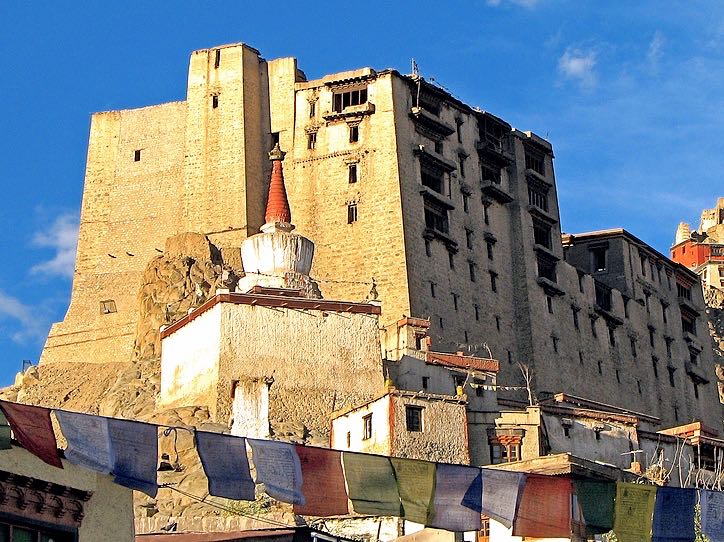
Lamayuru developed gradually rather than according to a single architectural plan. Its buildings occupy different levels of a steep rocky slope and are connected by stairways, passages, courtyards and narrow paths.
The complex includes assembly halls, temples, monks' residences, kitchens, storage rooms, chortens and meditation spaces. Whitewashed walls, dark wooden window frames, mud-brick construction and painted interior surfaces reflect traditional Ladakhi and Tibetan building techniques.
The architecture responds directly to the mountain. Structures are fitted onto narrow terraces, supported by stone and mud walls and clustered around the natural rock formation.
Dukhang
The main assembly hall is used for communal prayers, teachings and religious ceremonies. It contains sacred images, thangkas, painted decoration and seating for the monastic community.
Sengge Lhakhang
The Lion Temple is regarded as the oldest surviving structure at Lamayuru and is traditionally associated with the era of Rinchen Zangpo.
Naropa's Cave
This natural meditation space is connected by tradition with the Indian master Naropa and represents the earliest sacred layer of the site.
Chenrezig Lhakhang
The temple dedicated to Avalokiteshvara is particularly important for its unusual painted representation of the peaceful and wrathful deities associated with the intermediate state after death.
Chortens
Numerous chortens surround the monastery and village. They contain sacred symbolism and commemorate Buddhist teachings, teachers and religious merit.
Monastic Residences
Residential and service buildings support the monastery's continuing religious life, including accommodation, study, food preparation and administration.
The Paintings of Lamayuru
Lamayuru does not preserve one single, uniform period of painting. Its temples contain artistic work created or renewed during different stages of the monastery's long history.
The murals include images of Buddhas, Bodhisattvas, lineage masters, meditation deities, guardians, mandalas and narrative religious scenes. Painted wooden elements, decorative borders and hanging thangkas contribute to the visual environment of the temples.
Some paintings belong to later Tibetan artistic traditions, while older structures may preserve traces of artistic relationships extending toward Kashmir and the western Himalayan Buddhist world.
Because temples remained in active use, surfaces were sometimes repainted, repaired or altered. This means the paintings seen today may represent several periods rather than the work of one original group of artists.
The Rare Bardo Thodol Mural Cycle
One of Lamayuru's most unusual artistic treasures is found in the Chenrezig Lhakhang, the temple associated with Avalokiteshvara, the Bodhisattva of compassion.
Researchers have documented a large mural arrangement illustrating deities described in the Bardo Thodol, a Tibetan Buddhist cycle of teachings concerned with consciousness, death, the intermediate state and rebirth.
The mural includes peaceful and wrathful deities believed to arise during the stages between death and the next rebirth. These figures should not simply be understood as external gods or demons. Within the teaching, they can also represent manifestations of the mind and opportunities for liberation through recognition.
A complete monumental presentation of this subject is relatively unusual, making the Lamayuru paintings particularly valuable for the study of Tibetan Buddhist ritual art and beliefs concerning death and rebirth.
Understanding the Bardo Paintings
The Tibetan term bardo means an intermediate or transitional state. Although it is commonly associated with the period between death and rebirth, Tibetan Buddhist teachings recognise several transitional states, including waking life, meditation, dreaming, dying and becoming.
The painted deities in Lamayuru's Chenrezig temple form part of a carefully organised spiritual teaching. Peaceful figures express enlightened qualities such as wisdom and compassion, while wrathful figures represent powerful forms of the same awakened energy.
Their fierce expressions, flames, skull ornaments and dynamic postures are not intended merely to frighten viewers. They symbolise the destruction of ignorance, attachment, fear and harmful mental states.
The paintings function as sacred visual aids for ritual, contemplation and the transmission of religious knowledge. Their meaning is best understood within the guidance of trained Buddhist teachers rather than as decorative mythology alone.
Subjects Commonly Seen in Lamayuru's Sacred Art
- Shakyamuni Buddha and other enlightened Buddhas
- Avalokiteshvara, known in Tibetan as Chenrezig
- Guru Padmasambhava
- Drikung Kagyu lineage masters
- Peaceful and wrathful meditation deities
- Protective guardians of the Buddhist teachings
- Mandalas representing enlightened realms
- Offering goddesses and celestial figures
- Symbols of the cycle of death, bardo and rebirth
- Decorative clouds, flames, lotuses and auspicious symbols
How Traditional Murals Were Made
Traditional Himalayan wall paintings were generally created over prepared surfaces of mud plaster, clay and other locally available materials. Artists first smoothed the wall and established the composition with drawn guidelines.
Sacred figures were constructed according to established systems of proportion. Colours were then applied using mineral, earth and organic pigments mixed with suitable binding substances.
Workshops were usually organised under a master artist who understood both painting technique and Buddhist iconography. Creating a temple mural required religious knowledge because the position, colour, hand gesture, ornaments and attributes of every deity carried specific meaning.
The painting process was therefore both artistic and devotional. Before a sacred image became an object of worship, it was normally completed through ritual consecration.
Why the Paintings Need Protection
Ancient Himalayan murals are vulnerable to water infiltration, roof leakage, dust, soot, fluctuating humidity, structural movement and inappropriate repair materials.
Human activity can also cause damage. Touching painted walls, using flash, leaning against surfaces or allowing overcrowding in small temples may gradually harm fragile pigments and plaster.
Conservation must be handled by qualified specialists familiar with traditional Himalayan building materials. Applying modern cement, synthetic coatings or ordinary household paint can trap moisture and permanently damage historic surfaces.
Photography and Conservation
Photography may be restricted inside certain temples. Visitors should never assume that paying an entrance fee permits photography. Always follow the instructions of monks and caretakers, and never use flash near ancient paintings.
Yuru Kabgyat Festival
Lamayuru's Great Annual Monastic Celebration
The best-known festival at Lamayuru is Yuru Kabgyat. It is held according to the Tibetan lunar calendar, generally during the summer travel season.
During the festival, monks perform sacred masked dances known as Cham. They wear elaborate robes and masks representing Buddhist teachers, guardians and enlightened forces.
The dances are not staged merely as public entertainment. They form part of a ritual system intended to remove obstacles, overcome harmful forces, purify the environment and communicate Buddhist teachings.
The sound of drums, cymbals and long horns fills the monastery courtyard as monks perform carefully transmitted sequences. Local residents, pilgrims and visitors gather to receive blessings and witness the ceremonies.
Festival dates change each year because they follow the Tibetan lunar calendar. Travellers should confirm the official date before making plans.
Cham Masks and Their Meaning
Cham masks may depict protective deities, animals, teachers, guardians and symbolic forces connected with Buddhist teachings.
A fierce mask does not necessarily represent evil. Wrathful expressions often symbolise compassionate power directed against ignorance, violence, greed and spiritual obstruction.
The dances combine meditation, movement, music and visual symbolism. Monks normally receive training and ritual preparation before performing them.
How to Reach Lamayuru
Road Route from Leh
Lamayuru is located on or close to the Leh–Srinagar National Highway, approximately 115 to 125 kilometres west of Leh. The exact distance depends on the starting point and road route used.
The journey normally takes about three to four hours without long sightseeing stops. Road repairs, weather, traffic and seasonal conditions can increase the travel time.
Private taxis and organised tour vehicles are the most convenient options. Shared transport may be available, but schedules can be limited and should be checked locally.
Reaching Lamayuru from Kargil
Lamayuru can also be approached from Kargil along the Srinagar–Leh highway. The route crosses high mountain terrain and passes through areas near Namika La and Fotu La.
Driving time varies according to road conditions, stops and traffic. Travellers continuing between Kargil and Leh frequently visit Lamayuru along the way.
Best Time to Visit
Lamayuru can be visited during much of the year, but the most comfortable travel period is generally from May through October.
- May and June: Cooler weather, clearer roads and fresh mountain scenery.
- July and August: Warmer daytime conditions and the main travel season.
- September: Clear skies, attractive light and fewer visitors than the busiest summer weeks.
- October: Colder temperatures, quieter conditions and changing autumn colours.
- Winter: Possible with preparation, but temperatures are extremely cold and services may be limited.
Early morning and late afternoon provide particularly beautiful light on the Moonland formations. Interior temple access depends on monastery schedules and the availability of caretakers.
Altitude and Acclimatization
Lamayuru stands at approximately 3,500 metres above sea level. Although it is lower than some high-altitude destinations in Ladakh, newly arrived visitors can still experience symptoms of altitude sickness.
Travellers should acclimatize properly in Leh before making a long sightseeing journey. Drink sufficient water, avoid excessive alcohol, walk slowly and do not ignore headache, nausea, dizziness, unusual fatigue or breathing difficulty.
Anyone with worsening symptoms should descend and seek medical assistance. Lamayuru should not be used as a substitute for a proper acclimatization schedule after flying directly into Leh.
Visitor Etiquette
Respecting a Living Monastery
- Dress modestly inside temples and monastic areas.
- Remove hats when entering prayer halls.
- Keep voices low near monks, worshippers and ceremonies.
- Do not touch paintings, statues, manuscripts or ritual objects.
- Ask before photographing monks or local residents.
- Follow all restrictions on interior photography.
- Never use flash near paintings or thangkas.
- Walk clockwise around chortens and prayer structures.
- Do not interrupt prayers or cross directly in front of worshippers.
- Avoid entering rooms marked private or closed.
Places to Combine with Lamayuru
Lamayuru can be included in a longer Lower Ladakh and Sham Valley journey. Depending on available time, travellers may combine it with:
Alchi Monastery
Famous for its exceptional early Buddhist paintings and monumental sculptures connected with medieval Kashmiri artistic traditions.
Basgo
A historic fortified settlement containing palace ruins, temples and important images associated with Ladakh's royal history.
Likir Monastery
An important monastery of the Gelug tradition with a large outdoor Maitreya statue and views across the surrounding valley.
Wanla Monastery
A smaller historic monastery reached through a scenic side valley and known for its early temple and sculptures.
Indus–Zanskar Sangam
The dramatic meeting point of the Indus and Zanskar rivers near Nimmu.
Fotu La
A high mountain pass west of Lamayuru on the Leh–Srinagar highway, offering broad views of the surrounding ranges.
Suggested Day Trip from Leh
Lamayuru can technically be visited as a long day trip from Leh, but the journey involves several hours of driving. An early departure is essential.
- Depart Leh early in the morning.
- Drive through Nimmu, Basgo and Khalsi.
- Stop at a Moonland viewpoint before entering the village.
- Visit Lamayuru Monastery respectfully.
- Have lunch in Lamayuru or Khalsi.
- Return toward Leh with selected stops in the Lower Indus Valley.
Staying overnight provides a quieter experience and allows visitors to see the landscape under softer evening and morning light.
Where to Stay
Lamayuru village has locally operated guesthouses, homestays and small hotels. Facilities are generally simpler than those available in Leh, but staying locally supports village families and reduces the pressure of a rushed return journey.
Availability can be limited during festivals and the busiest travel period. Travellers should confirm accommodation in advance and carry sufficient cash because digital payments and network connections may not always be reliable.
Responsible Travel at Lamayuru
- Use refillable water bottles and avoid single-use plastic.
- Carry all non-biodegradable waste back to Leh.
- Choose locally operated accommodation and food services.
- Do not climb fragile Moonland formations.
- Remain on established paths around the monastery.
- Do not fly drones without proper permission.
- Respect private homes, farmland and monastic areas.
- Purchase local crafts directly from genuine producers when possible.
Important Facts About Lamayuru
- Lamayuru is one of Ladakh's oldest and most important active monasteries.
- Its sacred history is closely associated with the Indian master Naropa.
- Naropa's meditation cave is preserved within the monastery complex.
- The oldest surviving temple is traditionally associated with the period of Rinchen Zangpo.
- The monastery originally had a larger arrangement of several principal temples.
- Lamayuru is now an important centre of the Drikung Kagyu tradition.
- The Chenrezig temple contains a rare monumental mural representation of deities associated with the Bardo Thodol teachings.
- The surrounding Moonland formations are connected with ancient lake sediment shaped by erosion.
- Yuru Kabgyat is Lamayuru's best-known annual monastic festival.
- Lamayuru is an important heritage site but is not currently a UNESCO World Heritage Site.
Why Every Visitor Should Experience Lamayuru
Lamayuru is a place where landscape, legend and living Buddhist practice meet. Naropa's meditation cave recalls the travelling masters who carried Buddhist teachings across the Himalayas. The old temples preserve the memory of the great translation period, while the murals, rituals and masked dances demonstrate that this heritage remains alive.
Beyond its famous Moonland views, Lamayuru offers a deeper understanding of Ladakh as a centre of spiritual learning, artistic exchange and mountain community life. A respectful visit reveals not simply an ancient monument, but a continuing sacred tradition shaped over nearly a thousand years.
Research Basis
This article was prepared using information from the official Lamayuru Monastery website, Government of India tourism material, UNESCO World Heritage records, historical studies of Ladakh and published academic research concerning the Chenrezig Lhakhang and its Bardo Thodol murals.
Traditional accounts concerning Naropa, the ancient lake and royal healing are presented as sacred or monastic traditions rather than as independently proven historical events.
About this guide
Published by the Ladakh.com Editorial Team to help travelers understand Ladakh and plan more carefully. Conditions involving permits, roads, weather, altitude and local access can change, so reconfirm time-sensitive information before travel. About Ladakh.com