The History of Ladakh
Discover how an isolated high-altitude landscape became a meeting place of Tibetan, Indian, Central Asian and Himalayan civilizations, producing one of Asia's most distinctive cultural regions.
How Did Ladakh Come Into Existence?
Ladakh did not come into existence through one single event. The region developed gradually through migration, settlement, warfare, religious exchange, royal consolidation and international trade. Its high valleys were inhabited long before a unified Ladakhi kingdom appeared.
Ladakh's location explains much of its history. It lies between the Tibetan Plateau, the Kashmir region, the Karakoram, Baltistan and the routes leading toward Central Asia. Mountain passes that appear remote today were once vital corridors for merchants, pilgrims, soldiers, monks and diplomatic missions.
Over many centuries, local communities interacted with Dardic, Tibetan, Kashmiri, Balti, Central Asian and northern Indian peoples. From these encounters emerged a distinctive Ladakhi civilization with its own language, architecture, religious traditions, political institutions and agricultural way of life.
The Name “Ladakh”
A land known through several languages and historical traditions
Ladakh is commonly interpreted as meaning the “land of high passes.” The name is associated with Tibetan and Ladakhi expressions referring to mountain passes, an appropriate description for a region whose communities were connected by difficult routes crossing high ridges.
Historical sources used different names for various parts of the region. Western Tibetan traditions referred to the kingdom of Maryul, while outside travellers often described Ladakh as “Little Tibet” because of its Tibetan-derived language, Buddhist institutions and architectural traditions.
The modern territory called Ladakh contains several historically distinct cultural areas, including Leh, Nubra, Changthang, Sham, Purig, Drass, Suru and Zanskar. These regions did not always share the same political history, even when they were later administered together.
Earliest Inhabitants and Prehistoric Ladakh
Life in the high valleys before the creation of a unified kingdom
Archaeological evidence demonstrates that people travelled through and occupied the high valleys of Ladakh long before the appearance of written royal history. Rock carvings, burial sites, fort remains and ancient settlements reveal repeated contact between the Indus Valley, the Tibetan Plateau, Kashmir, Baltistan and Central Asia.
Ladakhi traditions and historical studies frequently identify Dardic and Mon populations among the region's earliest known inhabitants. The term “Dard” has been used for several communities speaking Indo-Aryan languages in parts of the western Himalaya. Communities in villages such as Dha, Hanu, Darchik and Garkon preserve distinctive linguistic and cultural traditions.
The word “Mon” appears in Himalayan historical traditions in several ways and does not always describe one clearly defined population. In Ladakhi accounts, Mon groups are often associated with early settlement, craftsmanship, music and cultural influences from areas south and west of the Tibetan Plateau.
Rock Art
Petroglyphs depicting animals, hunters, riders, religious symbols and human figures preserve evidence of ancient movement and cultural exchange.
Early Settlements
Communities developed around river valleys, springs and cultivable land where irrigation made barley farming and permanent settlement possible.
Migration and Exchange
Ladakh's population developed through interaction among multiple Himalayan and trans-Himalayan communities rather than through one isolated ethnic origin.
Ladakh and the Tibetan Empire
The political and cultural transformation of the western Himalaya
During the expansion of the Tibetan Empire, areas corresponding to present-day Ladakh came under strong Tibetan political influence. Tibetan military and administrative power extended westward across the plateau and into strategic Himalayan corridors.
This period accelerated the spread of Tibetan language and culture, although earlier local populations did not disappear. Ladakh's later identity emerged from the interaction of Tibetan-speaking settlers and rulers with communities already living in the western Himalaya.
The Tibetan Empire declined during the ninth century. Its political fragmentation created new regional kingdoms in western Tibet and the neighbouring Himalayan territories. This breakup prepared the way for the development of a separate Ladakhi kingdom.
The Formation of Maryul
The beginning of a recognizable Ladakhi kingdom
After the collapse of the Tibetan imperial order, descendants of the Tibetan royal house established authority in western Tibet. Historical tradition associates Nyima-Gon, also written as Nyimagon, with the consolidation of a large western Tibetan realm during the early tenth century.
According to traditional accounts, Nyima-Gon's territories were divided among his sons. The western portion known as Maryul became the foundation of the early Ladakhi kingdom. Maryul included the upper Indus region and, at different times, areas extending toward neighbouring valleys.
The creation of Maryul did not establish fixed modern borders. Medieval power depended on forts, villages, tributary relationships, passes, grazing lands and control of trade routes. Boundaries changed repeatedly through alliances, marriages and warfare.
The early kings gradually brought scattered valleys and local chiefs into a larger political system. This process created the historical foundation from which the later kingdom of Ladakh developed.
The Growth of Buddhism in Ladakh
Kashmiri artistry, Tibetan teachings and royal patronage
Buddhism reached the broader western Himalayan region in ancient times, but Ladakh's major Buddhist transformation occurred over several periods. Early royal patrons looked both toward western Tibet and toward Kashmir, which was an important centre of Buddhist scholarship and artistic production.
During the revival often called the “Second Diffusion” of Buddhism in Tibet, western Himalayan kingdoms supported translators, teachers, artists and monastery construction. Rinchen Zangpo, the celebrated translator active around the turn of the first millennium, is traditionally associated with a network of religious foundations across western Tibet and the western Himalaya.
The monasteries and temples at Alchi, Mangyu, Sumda and related sites preserve extraordinary artistic traditions. Their paintings and sculptures demonstrate connections between Tibetan Buddhist ideas, Kashmiri craftsmanship and local Ladakhi patronage.
Monasteries as Institutions
Monasteries became centres of religious education, ritual, artistic production, manuscript preservation and social life. They also developed close relationships with royal families, village communities and landholding systems.
A Distinctive Buddhist Culture
Ladakh received many schools and lineages of Tibetan Buddhism. Over time, Buddhist festivals, masked dances, chanting, architecture, painting and household rituals became central elements of Ladakhi cultural identity.
The Rise of the Namgyal Dynasty
A new royal house and the consolidation of Ladakhi power
Political instability and struggles among royal branches eventually gave rise to the Namgyal dynasty. The name “Namgyal” is commonly translated as “victorious.” The dynasty became the ruling house most closely associated with the classical kingdom of Ladakh.
Namgyal kings worked to consolidate rival territories, strengthen forts, build monasteries and control important trade routes. Their authority extended unevenly across the region and was repeatedly challenged by neighbouring powers.
The dynasty's rise was not only a military development. Royal patronage contributed to the building of religious institutions, palaces, settlements and monuments that continue to shape Ladakh's historical landscape.
Unifying the Valleys
Namgyal rulers attempted to bring local principalities and strategic valleys under a more centralized royal authority, although regional chiefs continued to exercise influence.
Monasteries and Monuments
Royal families sponsored monasteries, statues, temples, stupas and manuscripts, creating a visible link between political authority and Buddhist devotion.
Sengge Namgyal and the Height of Royal Ladakh
The “Lion King” and one of Ladakh's most celebrated periods
Sengge Namgyal, whose name means “Victorious Lion,” is remembered as one of Ladakh's greatest kings. During the early seventeenth century, his reign became associated with military expansion, royal building, trade and strong support for Buddhist institutions.
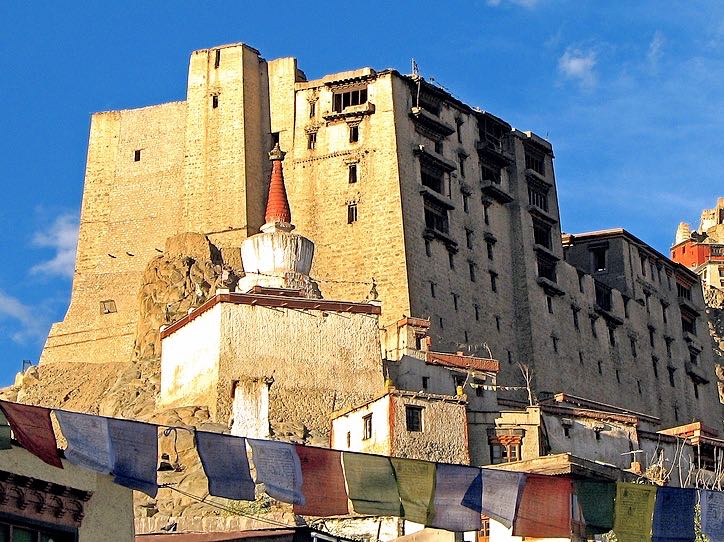
The nine-storey Leh Palace is traditionally associated with the Namgyal royal period and dominates the old capital from its rocky ridge. Its design reflects Tibetan-style fortress-palace architecture, with massive earthen walls, timber construction and layered interior spaces.
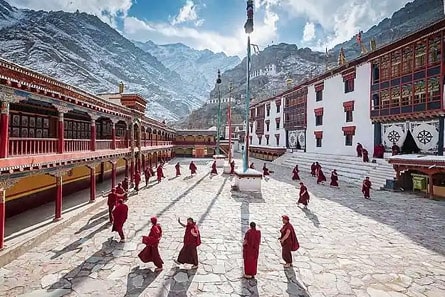
Sengge Namgyal also supported monasteries and religious teachers, particularly the Drukpa Kagyu tradition. Hemis Monastery became one of the most important religious institutions associated with royal patronage during this era.
Leh Palace and Old Leh
The palace symbolized the authority of the Namgyal kings, while the town below developed as an administrative centre and a marketplace serving long-distance caravan trade.
Basgo, Shey and Hemis
Fortifications, palaces, temples and monasteries associated with the Namgyal period illustrate the close connection between royal government, religion and control of the Indus Valley.
The Ladakh–Tibet–Mughal War
Regional rivalry, religious politics and the Treaty of Tingmosgang
During the late seventeenth century, Ladakh entered a major conflict with the Tibetan government. The struggle reflected political competition, territorial disputes and tensions involving different Buddhist religious affiliations.
Tibetan forces advanced into Ladakh and threatened the kingdom. Ladakh sought military assistance from the Mughal authorities in Kashmir. The resulting war involved Ladakhi, Tibetan and Mughal interests and caused serious disruption.
The conflict ended with the Treaty of Tingmosgang in 1684. Although the original treaty document has not survived, its terms are summarized in the Ladakh Chronicles. The settlement regulated relations between Ladakh and Tibet, addressed trade and referred to their frontier.
The war also deepened Ladakh's relationship with Kashmir. Later traditions associate the settlement with political and religious concessions, while Leh's Muslim community and mosque became lasting symbols of Ladakh's connections with the Islamic world of Kashmir and Central Asia.
Ladakh and the Trans-Himalayan Trade Routes
A commercial crossroads between South Asia, Tibet and Central Asia
Ladakh is often described as part of the wider Silk Route world. It was not situated on only one road; instead, a network of difficult mountain routes connected Leh and other settlements with Kashmir, Punjab, Baltistan, Yarkand, Khotan, western Tibet and the Indian plains.
Leh became a major caravan centre where merchants, brokers, transporters, pilgrims and officials from different regions met. Caravans crossed passes with horses, mules, yaks and Bactrian camels, carrying goods across immense distances.
Pashmina Wool
Fine wool from the Changthang and western Tibetan plateau travelled through Ladakh toward Kashmiri weaving centres.
Tea and Textiles
Tea, cotton cloth, brocades, silk and manufactured goods moved between the Tibetan Plateau, Central Asia and India.
Salt and Borax
Salt, borax and other plateau products formed an important part of regional exchange and village economies.
Caravan Animals
Horses, ponies, mules, yaks and double-humped Bactrian camels enabled commerce across deserts, valleys and high passes.
Leh's Bazaars
Merchants maintained warehouses, caravanserais and trading relationships in and around Leh's historic market.
Exchange of Ideas
Trade carried languages, food, clothing, artistic styles, religious traditions and social relationships as well as goods.
Islam and Ladakh's Cultural Diversity
Centuries of contact with Kashmir, Baltistan and Central Asia
Islam became established in parts of the wider Ladakh region through trade, migration, missionary activity, political relationships and connections with Kashmir and Baltistan. Its growth was particularly important in Purig, the area that includes much of present-day Kargil.
Muslim merchants also became an important part of Leh's commercial society. Sunni, Shia and Nurbakhshi traditions developed in different areas, contributing to Ladakh's religious and cultural diversity.
Ladakh's history should therefore not be described only as a Buddhist history. Buddhist monasteries and royal institutions are highly visible, but Muslim communities, artisans, traders, farmers, scholars and local rulers also shaped the region over many centuries.
Cultural exchange can be seen in language, food, music, clothing, architecture, marriage traditions and commercial networks. Ladakh's identity grew from interaction among communities rather than from complete isolation.
The Dogra Conquest of Ladakh
The end of Ladakh as an independent Himalayan kingdom
In 1834, Dogra forces under General Zorawar Singh entered Ladakh. After military campaigns and resistance from Ladakhi forces, the Namgyal kingdom lost its political independence.
The Dogras subsequently extended their power toward Baltistan. Zorawar Singh later launched a campaign into western Tibet in 1841. His forces initially advanced but suffered severely during the winter, and Zorawar Singh was killed.
Tibetan forces counterattacked and advanced into Ladakh before being defeated. Peace was restored in 1842 through an agreement commonly called the Treaty of Chushul. The agreement affirmed peace and referred to the maintenance of traditionally established frontiers.
The Dogra conquest marked a decisive historical change. Ladakh's kings retained limited status and property, but the region was no longer an independent kingdom. It became part of a larger state governed from Jammu.
Ladakh Within the Princely State of Jammu and Kashmir
Dogra administration, British influence and changing trade networks
Following the political changes of the mid-nineteenth century, Ladakh became part of the princely state of Jammu and Kashmir under the Dogra rulers. The region was administered through officials, taxation systems and local intermediaries.
British strategic interest increased because Ladakh bordered routes leading toward Central Asia, Tibet and territories influenced by Russia and China. British officials, surveyors, explorers and travellers passed through the region, documenting geography, languages, trade and political conditions.
Caravan trade remained economically important into the early twentieth century. Leh continued to function as a commercial meeting point, although political boundaries and changing transportation systems gradually transformed the older trade economy.
Missionaries, scholars and explorers also contributed written accounts of Ladakh. These records are historically valuable but must be read alongside Ladakhi, Tibetan, Persian, archaeological and oral sources because foreign observers often interpreted local society through their own political and cultural assumptions.
Ladakh During the Political Changes of 1947–1948
Accession, invasion and the division of historical regions
When British rule in the Indian subcontinent ended in 1947, the princely state of Jammu and Kashmir became the subject of conflict. The Maharaja signed an Instrument of Accession to India in October 1947 amid an invasion of the state.
Fighting spread into the Ladakh region. Leh faced isolation and military danger, while Kargil, Drass, Skardu and surrounding areas became strategically important. Air access, local defence efforts and military operations played an important role in maintaining control of Leh.
The ceasefire of 1949 left the former princely state divided. Historical routes connecting Ladakh with Baltistan and parts of Central Asia were disrupted. Communities that had traded, travelled and maintained family relationships across these regions became separated by a militarized boundary.
Ladakh remained within the Indian state of Jammu and Kashmir. Its geographic isolation, border position and cultural differences increasingly shaped demands for greater administrative attention and local political representation.
Ladakh and the Modern Border Era
How international boundaries transformed an old trading crossroads
The India–China Conflict of 1962
Competing territorial claims and increasing military tension led to war between India and China in 1962. Fighting occurred in areas of Ladakh, permanently strengthening the region's strategic military importance and restricting older routes.
The Kargil Conflict of 1999
In 1999, conflict took place in the Kargil sector after armed intrusions across the Line of Control. The fighting brought international attention to Drass, Kargil, Batalik and the extreme conditions faced by soldiers in high-altitude warfare.
Modern boundaries transformed Ladakh from a commercial crossroads into a sensitive border region. Routes toward Yarkand, Tibet and Baltistan that once carried regular caravans became restricted or closed. Road construction and military infrastructure then created new forms of movement within the region.
Administrative Change and Autonomous Hill Councils
Growing demands for regional representation and local planning
Ladakh was administered as one district for part of the post- independence period. In 1979, it was divided into the separate districts of Leh and Kargil to decentralize administration and development.
Demands for greater autonomy continued, particularly in response to Ladakh's distinctive geography, languages, religious traditions and development challenges. The Ladakh Autonomous Hill Development Council, Leh, came into existence in 1995.
The council introduced a form of decentralized local governance with elected representatives involved in planning and development. A separate Ladakh Autonomous Hill Development Council for Kargil was established in 2003.
LAHDC Leh
The Leh council began functioning in 1995, giving elected local representatives a larger role in district-level development, planning and administration.
LAHDC Kargil
The Kargil council came into existence in 2003, extending the autonomous hill council system to the western part of Ladakh.
The Formation of the Union Territory of Ladakh
A major administrative transformation in 2019
In August 2019, the Parliament of India passed the Jammu and Kashmir Reorganisation Act. The former state was reorganized into the Union Territory of Jammu and Kashmir and the Union Territory of Ladakh. The new arrangement came into effect on 31 October 2019.
The Union Territory of Ladakh was formed without its own legislative assembly and was administered by a Lieutenant Governor. Leh and Kargil continued to maintain their autonomous hill development councils.
The change fulfilled a long-standing demand among sections of the population, especially in Leh, for separation from the former state administration. Reactions across Ladakh were not identical, and subsequent public discussion has focused on political representation, constitutional safeguards, employment, land, environmental protection and regional balance.
Ladakh's political story therefore remains active. Its modern institutions continue to evolve while communities debate how to protect local culture and fragile ecosystems while pursuing education, infrastructure and economic opportunity.
Ladakh's Living Historical Heritage
Palaces, monasteries, forts, mosques and caravan settlements
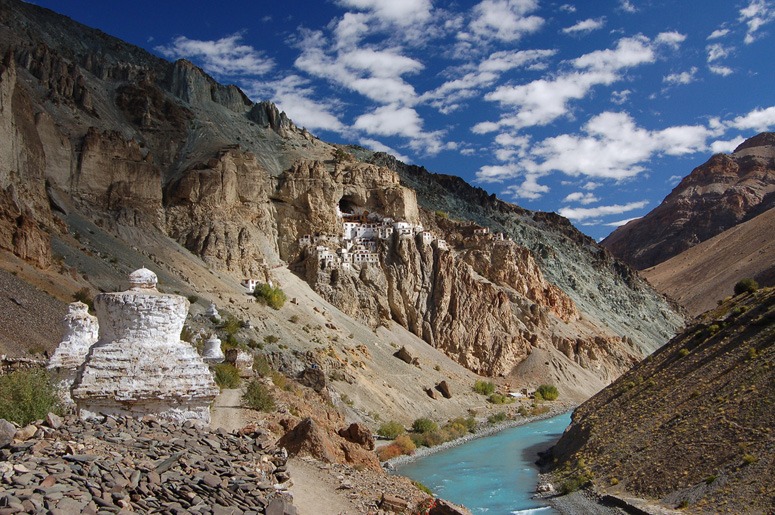
Ladakh's history survives not only in books but also in its physical landscape. Ancient rock art, ruined forts, royal palaces, monasteries, mosques, stupas, irrigation systems, old houses and caravan routes preserve evidence from many historical periods.
Leh Palace
The former royal palace dominates old Leh and represents the architectural and political ambition of the Namgyal era.
Shey Palace
Shey served as an important royal centre before Leh became the principal capital and retains major Buddhist monuments.
Basgo
Basgo's fortifications and temples recall political conflict, royal patronage and the strategic importance of the lower Indus Valley.
Alchi
Alchi preserves outstanding early Buddhist paintings and sculptures showing artistic connections with Kashmir and western Tibet.
Lamayuru
One of Ladakh's most celebrated monastic landscapes, Lamayuru reflects the long history of Buddhist institutions in western Ladakh.
Old Leh and the Jama Masjid
The old town, market, mosque and merchant neighbourhoods preserve the memory of Leh's multi-religious caravan society.
Hemis Monastery
Hemis became a leading Drukpa institution and remains famous for its monastic collection, rituals and annual festival.
Kargil and Purig
Historic settlements in Purig reflect Ladakh's Islamic, Buddhist, Balti, Kashmiri and trans-Himalayan connections.
Zanskar
Remote monasteries, fort sites and villages preserve a distinctive historical landscape shaped by winter isolation and connections across high passes.
Intangible Heritage
Ladakh's living heritage includes Buddhist chanting, oral histories, folk songs, masked dances, wedding customs, polo, traditional medicine, weaving, metalwork, woodwork, irrigation management, agricultural festivals and highly developed systems of cooperation adapted to a difficult mountain environment.
UNESCO added the Buddhist chanting of Ladakh to the Representative List of the Intangible Cultural Heritage of Humanity in 2012, recognizing a ritual tradition maintained in monasteries and villages.
Complete Historical Timeline of Ladakh
A concise chronology of the region's major transformations
Settlement, Rock Art and Migration
Early communities occupied Ladakh's valleys and used routes connecting the Indus region with Tibet, Kashmir, Baltistan and Central Asia. Rock carvings preserve evidence of these contacts.
Tibetan Imperial Influence
The expanding Tibetan Empire brought political and cultural change to the western Himalayan region, strengthening the use of Tibetan language and institutions.
Fragmentation of the Tibetan Empire
The decline of central Tibetan power allowed new western Tibetan and Himalayan kingdoms to emerge.
Formation of Maryul
Traditional history links the establishment of Maryul to the descendants of Nyima-Gon, creating the foundation of the early Ladakhi kingdom.
Buddhist Revival and Artistic Exchange
Royal and religious patronage supported monasteries, translation and artistic connections between western Tibet, Ladakh and Kashmir.
Rise of the Namgyal Dynasty
The Namgyal royal house consolidated power and became the principal dynasty associated with the historic kingdom of Ladakh.
Reign of Sengge Namgyal
Royal authority, architecture, trade and monastic patronage expanded. Leh Palace and major religious projects are associated with this celebrated era.
Ladakh–Tibet–Mughal War
Tibetan forces invaded Ladakh, and the Ladakhi kingdom sought assistance from Mughal Kashmir. The conflict ended with the Treaty of Tingmosgang.
Expansion of Caravan Trade
Leh became an important commercial meeting point within networks linking Central Asia, Tibet, Kashmir and northern India.
Dogra Invasion
Dogra troops commanded by Zorawar Singh invaded Ladakh, bringing the independent Namgyal kingdom to an end.
Dogra–Tibetan War and Peace Agreement
Following a Dogra campaign into western Tibet and a Tibetan counterattack, peace was restored through the agreement commonly known as the Treaty of Chushul.
Princely State Administration
Ladakh formed part of the princely state of Jammu and Kashmir while remaining an important frontier and trading region.
War and Division
Conflict following the end of British rule divided historical routes and territories, permanently changing Ladakh's access to Baltistan and Central Asia.
India–China War
Fighting in Ladakh strengthened the region's strategic role and contributed to the militarization of the modern frontier.
Creation of Leh and Kargil Districts
The former Ladakh district was divided into the separate districts of Leh and Kargil.
LAHDC Leh Established
The Ladakh Autonomous Hill Development Council in Leh created a new system of elected, decentralized local governance.
Kargil Conflict
High-altitude fighting in the Kargil sector once again demonstrated Ladakh's strategic significance.
LAHDC Kargil Established
Kargil received its own autonomous hill development council.
Union Territory of Ladakh
Ladakh became a separate Union Territory of India under the Jammu and Kashmir Reorganisation Act, 2019.
| Period | Political Development | Historical Importance |
|---|---|---|
| Ancient Period | Independent settlements and regional contacts | Created Ladakh's early multicultural foundations |
| Tibetan Imperial Era | Western expansion of Tibetan political influence | Strengthened Tibetan language and institutions |
| Maryul Kingdom | Regional monarchy developed after Tibetan fragmentation | Foundation of the historical Ladakhi state |
| Namgyal Dynasty | Royal consolidation and expansion | Produced Ladakh's best-known palaces and monasteries |
| Dogra Period | Ladakh incorporated into a larger Jammu-based state | Ended the independent kingdom |
| Post-1947 Period | Ladakh remained within Jammu and Kashmir, India | Borders and conflict transformed older trade networks |
| Autonomous Council Era | Local councils established in Leh and Kargil | Expanded decentralized planning and representation |
| Since 2019 | Separate Union Territory of Ladakh | Created a new administrative and political framework |
Research and Historical Sources
This article was prepared using a combination of official records, recognized historical works, heritage documentation and international cultural sources. Early dates and territorial descriptions may vary among historians because the surviving evidence is incomplete.
- The Ladakh Chronicles and historical studies based upon them
- Administration of the Union Territory of Ladakh
- District Administration Leh and District Administration Kargil
- Ministry of Home Affairs, Government of India
- UNESCO World Heritage and Intangible Cultural Heritage records
- Indira Gandhi National Centre for the Arts
- Academic studies of Ladakh's kingdoms, trade and western Himalayan politics
- LAHDC heritage documentation and mapping initiatives
Experience Ladakh's History With Local Experts
Explore monasteries, royal palaces, old caravan towns, traditional villages and archaeological landscapes with knowledgeable local guides and tour operators listed on Ladakh.com.
Find Local Ladakh Tour OperatorsAbout this guide
Published by the Ladakh.com Editorial Team to help travelers understand Ladakh and plan more carefully. Conditions involving permits, roads, weather, altitude and local access can change, so reconfirm time-sensitive information before travel. About Ladakh.com