Leh Ladakh
Hemis Monastery: History, Sacred Art and the Great Drukpa Heritage of Ladakh
Explore the royal foundation, Drukpa Kagyu lineage, sacred paintings, museum treasures, monumental thangkas, ritual dances and living traditions of one of Ladakh's most important monasteries.
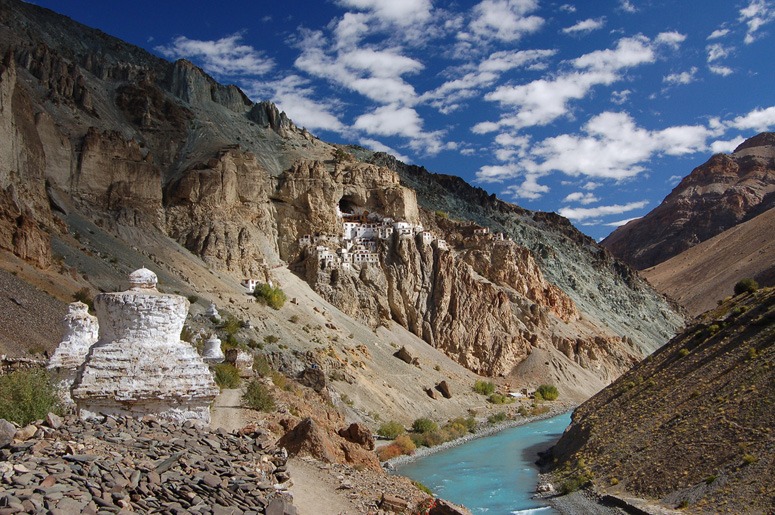
Hidden within a side valley south of the Indus River, Hemis Monastery stands beneath rugged mountain walls approximately 40 to 45 kilometres southeast of Leh. Unlike monasteries that dominate an open hilltop, Hemis is partly concealed within the folds of the mountains, creating a sense of spiritual seclusion before visitors enter its large ceremonial courtyard.
Hemis is one of Ladakh's most influential Buddhist institutions and the principal centre of the Drukpa Kagyu lineage in the region. Its present form developed mainly during the 17th century through the partnership of the Ladakhi king Sengge Namgyal and the eminent Buddhist master Stagtsang Raspa.
The monastery is widely known for the annual Hemis Tsechu Festival, when monks perform sacred Cham dances in honour of Guru Padmasambhava. Beyond the festival, Hemis preserves an exceptional collection of paintings, sculptures, manuscripts, ceremonial objects, textiles and religious treasures accumulated over centuries.
Hemis remains a living centre of worship, education and pilgrimage. Its temples and museum should therefore be understood not simply as tourist attractions, but as parts of an active Buddhist institution.
Why Hemis Monastery Is Important
Hemis holds a central position in Ladakh's religious and political history. It served as the principal monastic seat of the Drukpa Kagyu tradition and enjoyed strong patronage from the Namgyal royal family.
Royal support provided land, estates, resources and protection, enabling Hemis to develop a large monastic community and acquire important religious objects. Its influence extended to affiliated monasteries, village communities and pilgrimage sites across Ladakh.
The monastery's importance is also artistic. Hemis preserves several layers of Himalayan Buddhist art, including large wall paintings, painted wooden galleries, thangkas, metal sculptures, ritual masks, jewellery, manuscripts and ceremonial textiles.
The monastery museum contains objects representing religious practice, royal patronage and artistic exchange between Ladakh, Tibet, Kashmir and other Himalayan regions.
Heritage clarification: Hemis is one of Ladakh's most important Buddhist heritage sites, but it is not currently inscribed as an individual UNESCO World Heritage Site. It should be described as a nationally and internationally significant monastery rather than as a UNESCO-listed monument.
Earlier Sacred History of Hemis
Although the present monastery is principally associated with the 17th century, Buddhist activity in the Hemis and Shang valleys is believed to be older.
The wider landscape contains meditation caves and pilgrimage places associated with early Drukpa masters. These sacred sites suggest that religious practitioners visited the area before the large royal monastery was built.
Historical accounts connect the region with Gotsangpa Gonpo Dorje, an important early master of the Drukpa tradition. He is believed to have meditated in a cave above the valley, now associated with the Gotsang retreat.
The existence of this earlier sacred landscape explains why Stagtsang Raspa later chose Hemis as a major seat of the Drukpa lineage.
The Drukpa Kagyu Tradition
Hemis belongs to the Drukpa Kagyu school of Tibetan Buddhism. The Kagyu traditions emphasise meditation, direct spiritual transmission and teachings traced through Indian and Tibetan masters.
The broader Kagyu lineage traces its transmission through the Indian Mahasiddhas Tilopa and Naropa, followed by Marpa the Translator, Milarepa and Gampopa.
The Drukpa branch emerged in Tibet through the teachings of Tsangpa Gyare Yeshe Dorje during the 12th century. It later spread through Himalayan regions, including Bhutan, Ladakh and parts of western Tibet.
Drukpa religious practice combines philosophical study, monastic discipline, meditation, ritual and devotion to lineage masters. Hemis became its most important institutional centre in Ladakh.
Who Built Hemis Monastery?
King Sengge Namgyal and Stagtsang Raspa
The establishment of the present Hemis complex is associated with two powerful figures: the Ladakhi ruler Sengge Namgyal and the Buddhist master Stagtsang Raspa.
Sengge Namgyal, remembered as the Lion King of Ladakh, ruled during the first half of the 17th century. His reign was marked by military expansion, major architectural projects and support for Buddhist institutions.
Stagtsang Raspa was a respected Drukpa Kagyu teacher whose spiritual influence extended across the western Himalayan region. He became an important religious adviser to the king.
Together, royal power and religious leadership created Hemis as a major monastic centre. The king provided patronage and resources, while Stagtsang Raspa established its spiritual lineage, ritual authority and institutional purpose.
Sengge Namgyal: The Lion King of Ladakh
Sengge Namgyal was one of the most influential rulers in Ladakhi history. His name means Lion of Victory, and his reign represented a period of political strength and ambitious building activity.
He is associated with the development or expansion of major monuments, including Leh Palace, Basgo temples and several monasteries. His building programme expressed both royal authority and devotion to Buddhism.
The king's relationship with Stagtsang Raspa strengthened the position of the Drukpa Kagyu school in Ladakh. Hemis became the leading monastery of this tradition and received significant royal support.
Later royal patrons continued to support Hemis, contributing religious objects, land and wealth. This long relationship explains why Hemis became known as one of Ladakh's wealthiest monasteries.
Stagtsang Raspa: Spiritual Founder of Hemis
The Master Behind the Monastery
Stagtsang Raspa, whose name is written in several different forms in English, was a prominent master of the Drukpa Kagyu lineage.
He travelled extensively, taught Buddhist philosophy and meditation and established relationships with rulers and religious communities across the Himalayan world.
At Hemis he created a permanent institutional seat from which the Drukpa teachings could be transmitted throughout Ladakh.
His role was not simply ceremonial. The organisation of the monastery, its lineage practices, rituals, monastic discipline and connection with affiliated religious centres developed under his spiritual authority.
Images of Stagtsang Raspa and other Drukpa masters appear in Hemis's temples and paintings, establishing a visible chain of transmission from earlier Indian and Tibetan teachers to the Ladakhi monastic community.
Historical Development of Hemis
Early Drukpa Sacred Landscape
Meditation caves and traditions associated with masters such as Gotsangpa established the religious importance of the Hemis and Shang valleys before the present monastery was developed.
Early 17th Century
Stagtsang Raspa arrived in Ladakh and developed a close relationship with King Sengge Namgyal.
17th-Century Royal Foundation
The king and Stagtsang Raspa established Hemis as the leading Drukpa Kagyu monastery in Ladakh. Construction, land grants and artistic commissions followed.
Later Namgyal Period
Successive rulers and religious patrons donated sculptures, paintings, ritual objects, estates and manuscripts to the monastery.
19th and 20th Centuries
Hemis continued as a major pilgrimage and monastic centre while attracting explorers, scholars and travellers interested in Ladakh's religious heritage.
Present Day
The monastery remains an active religious institution, museum, educational centre and venue for the annual Hemis Tsechu festival.
Architecture of Hemis Monastery
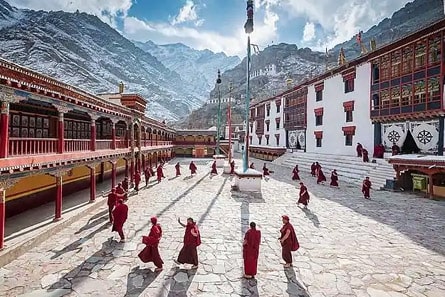
Hemis is organised around a large rectangular stone-paved courtyard. Two principal temple buildings face the courtyard, while residential galleries, balconies and monastic rooms surround the ceremonial space.
Whitewashed walls are framed by red, ochre, black and gold architectural details. Carved wooden balconies and painted beams introduce elaborate colour into the otherwise austere mountain environment.
The monastery is built against a steep rocky slope. Smaller temples, meditation rooms and retreat structures continue upward behind the main complex.
Unlike the vertically layered appearance of Thiksey, Hemis has a more enclosed courtyard arrangement. This design provides a protected space for large ceremonies and masked dances.
The Great Courtyard
The courtyard is the public and ceremonial heart of Hemis. During ordinary days it appears spacious and quiet, but during the Hemis Festival it becomes the setting for elaborate rituals attended by monks, pilgrims and visitors.
Raised platforms, ceremonial flagpoles and surrounding balconies allow religious leaders, musicians and spectators to observe the ritual dances.
The courtyard's stone surface and surrounding buildings create a powerful acoustic environment for drums, cymbals, long horns and chanting.
Painted galleries around the courtyard contain important images, including the celebrated series of the Eighty-Four Mahasiddhas.
Main Temples and Sacred Spaces
Dukhang
The main assembly hall is used for communal prayers, ritual ceremonies, teachings and major religious observances. It contains sacred images, thangkas, offering tables and seating for monks.
Tshogkhang
This important ceremonial hall is associated with monastic gatherings, offerings and ritual assemblies. Its interior contains statues, paintings and religious furnishings.
Guru Lhakhang
A temple dedicated to Guru Padmasambhava, whose life and teachings are central to the Hemis Festival and Himalayan Vajrayana Buddhism.
Protector Chapels
These contain fierce guardian deities believed to protect the Buddhist teachings, monastery and surrounding communities from spiritual obstacles.
Monastic Library
The monastery preserves Buddhist scriptures, ritual texts, biographies, philosophical works and handwritten or printed religious manuscripts.
Hemis Museum
The museum displays thangkas, sculptures, ceremonial objects, weapons, jewellery, textiles and other treasures associated with the monastery and Ladakh's royal history.
Chortens
Chortens contain sacred texts, consecrated offerings or relics and represent the enlightened mind of the Buddha.
Gotsang Retreat
Located above the main monastery, this meditation site is connected with the early Drukpa master Gotsangpa and the sacred landscape that preceded the royal monastery.
The Paintings of Hemis
Hemis contains paintings created during different periods of its history. These include murals inside temples, decorative painting on wooden architecture, portable thangkas and the extensive painted galleries around the courtyard.
The paintings communicate religious teachings, lineage history and meditative symbolism. Figures are identified through their gestures, colours, clothing, attributes, posture and surrounding deities.
Hemis's artistic programme strongly reflects the Drukpa Kagyu tradition. Portraits of lineage masters appear alongside Buddhas, Bodhisattvas, Mahasiddhas, protective deities and Guru Padmasambhava.
Some paintings have been renewed or restored during the monastery's long history. Visitors should therefore avoid assuming that every visible mural belongs to the original 17th-century construction.
The Eighty-Four Mahasiddhas
One of the most remarkable painted cycles at Hemis represents the Eighty-Four Mahasiddhas, legendary tantric masters of medieval India.
The term mahasiddha means great accomplished one. These teachers were believed to have attained profound spiritual realization through meditation and Vajrayana practice.
They came from many social backgrounds. Traditional accounts include kings, monks, scholars, craftspeople, hunters, householders, yogis and individuals living outside conventional society.
Their stories demonstrate that awakening was not limited to one social class or monastic institution. Ordinary work, hardship and unconventional circumstances could become part of a spiritual path when transformed by wisdom and disciplined practice.
The Hemis paintings are especially valuable because they preserve a large visual genealogy connecting Ladakhi Buddhism with Indian tantric masters. Historical descriptions date the courtyard cycle mainly to the 17th century and record the use of mineral-based pigments.
Important Mahasiddhas Represented in Buddhist Art
- Tilopa: Indian master and source of the Kagyu transmission
- Naropa: Scholar and yogi whose teachings passed to Marpa
- Luipa: Mahasiddha associated with overcoming attachment and social pride
- Virupa: Celebrated tantric master connected with powerful yogic accomplishments
- Saraha: Poet and teacher known for songs of direct realization
- Ghantapa: Yogic master often shown with ritual attributes
- Kukkuripa: Siddha remembered for compassion and his relationship with a dog
- Mahipa: One of the accomplished figures represented in traditional lineages
The stories of individual Mahasiddhas vary among texts and traditions. Their paintings should be interpreted as part of a sacred lineage rather than as literal portraits made during their lifetimes.
Guru Padmasambhava at Hemis
Guru Padmasambhava, also known as Guru Rinpoche, holds a central place in the religious life of Hemis. He was an Indian tantric master traditionally credited with helping establish Buddhism in Tibet during the 8th century.
Himalayan traditions describe him as a master capable of transforming hostile forces into protectors of the Buddhist teachings.
He is commonly represented wearing a lotus-shaped hat, holding a vajra and skull cup and carrying a ritual staff called a khatvanga.
His images at Hemis may appear in peaceful, royal, yogic or wrathful forms. Each form communicates a different aspect of enlightened activity.
The Giant Guru Rinpoche Thangka
Hemis possesses a monumental appliqué thangka associated with Guru Padmasambhava. Large thangkas of this type are assembled from sections of coloured silk, brocade and embroidered fabric rather than being painted entirely on a single cloth.
The thangka is preserved in storage for most of the time and is displayed only on special ceremonial occasions. Traditional accounts associate its major public unveiling with a twelve-year cycle of the Tibetan calendar.
Such limited display protects the fragile textile and increases the religious importance of the occasion. Pilgrims believe that seeing the sacred image and making offerings can generate spiritual merit.
Festival programmes and unveiling schedules should always be confirmed with official monastery or Ladakh tourism sources, as dates depend on the Tibetan lunar calendar and ceremonial decisions.
Traditional Materials and Painting Methods
Himalayan murals were generally painted on carefully prepared layers of clay, mud plaster and fine surface material.
Artists first drew grids and outlines to establish the correct proportions of sacred figures. Colours were then applied using mineral, earth and organic pigments mixed with suitable binders.
Traditional palettes included red and yellow ochres, carbon black, mineral greens, blue pigments and white earth or mineral compounds.
Sacred paintings followed precise iconographic rules. A deity's hand gestures, facial expression, ornaments, number of arms and ritual objects identified its spiritual meaning.
After completion, the image was consecrated through religious ceremony, transforming the artwork into an active support for worship and meditation.
Peaceful and Wrathful Deities
Some Hemis paintings and masks depict fierce figures surrounded by flames, weapons, skull ornaments or powerful animals.
These images should not automatically be interpreted as evil. In Vajrayana Buddhism, wrathful forms often express the intense energy of compassion directed against ignorance, attachment and harmful forces.
Protector deities are believed to guard the teachings and spiritual community. Certain images may be covered, restricted or shown only during particular rituals.
Visitors must respect all instructions concerning access, photography and restricted protector chapels.
Hemis Monastery Museum
A Treasury of Ladakhi Buddhist Art
The Hemis Museum contains one of Ladakh's most important monastic collections. Objects were accumulated through royal patronage, religious donations, ritual use and the monastery's long institutional history.
The museum helps visitors understand that Ladakhi Buddhist art extends beyond monastery murals. Religious life also depended on portable images, ritual tools, manuscripts, clothing, musical instruments and ceremonial objects.
Exhibition arrangements may change, and some sacred objects are not displayed permanently.
Objects Preserved in the Museum
Thangkas
Painted or appliqué scrolls representing Buddhas, Bodhisattvas, lineage masters, mandalas and protective deities.
Metal Sculptures
Sacred images made from copper alloys, brass, silver and other metals, sometimes decorated with gilding and precious stones.
Ritual Masks
Masks used during Cham dances to represent teachers, guardians, animals and symbolic forces within Vajrayana ceremonies.
Manuscripts
Buddhist scriptures, ritual texts, biographies and philosophical commentaries written or printed in Tibetan script.
Royal Objects
Textiles, jewellery, weapons and ceremonial gifts reflecting the close historical relationship between Hemis and Ladakh's royal family.
Musical Instruments
Drums, cymbals, horns, bells and other instruments used in Buddhist prayer and festival ceremonies.
Why Hemis Became Known as a Wealthy Monastery
Hemis's wealth did not originate from modern tourism. It developed through centuries of royal patronage, agricultural estates, village contributions, pilgrimage offerings and donations from religious patrons.
The Namgyal rulers supported the monastery with land and valuable objects. Affiliated villages and estates supplied grain, butter, wool and other resources necessary for monastic life.
This material support allowed Hemis to maintain a large community, commission major works of art and preserve religious objects over many generations.
The description of Hemis as the richest monastery in Ladakh refers primarily to its historic collections, patronage and institutional resources rather than to ordinary commercial wealth.
The Hemis Tsechu Festival
Ladakh's Celebrated Festival of Guru Padmasambhava
The annual Hemis Tsechu is held in honour of Guru Padmasambhava. The word tsechu refers to the tenth day of a Tibetan lunar month, a date traditionally associated with important events in Guru Rinpoche's life.
Festival dates change each year because they follow the Tibetan lunar calendar. The celebration normally takes place during the summer travel season, but visitors must confirm the official dates before planning.
During the festival, monks conduct prayers, create ritual offerings and perform sacred masked dances called Cham.
The courtyard fills with monks, local residents, pilgrims and visitors. Drums, cymbals, long horns and wind instruments accompany the carefully choreographed dances.
The festival is not simply a cultural show. It is a religious ceremony intended to remove obstacles, protect the teachings and communicate Buddhist principles through movement, sound and symbolic costume.
The Meaning of Cham Dance
Cham is a form of ritual movement performed by trained monks. Each dancer represents a particular deity, protector, teacher, animal or symbolic presence.
The dancers do not perform as ordinary actors. Through meditation, costume and ritual preparation, they embody the enlightened qualities represented by the mask.
Wrathful figures may symbolise the destruction of ignorance and harmful mental states. Skeletal dancers remind viewers of impermanence and death. Black Hat dancers may perform rituals connected with purification and the removal of obstacles.
Circular movement reflects sacred cosmology, while drums and horns establish the ritual rhythm. The entire courtyard becomes a symbolic mandala during the performance.
Festival Masks and Costumes
Hemis Festival masks are constructed from materials such as papier-mâché, cloth, clay, wood and paint. Some are carefully preserved and reused for many years.
Silk robes, embroidered boots, aprons and ornaments identify the ritual character represented by each dancer.
Bright colours and exaggerated expressions allow the symbolic meaning to be seen across the large courtyard.
Visitors should not touch masks, costumes or ritual objects. These are consecrated items rather than ordinary festival decorations.
Daily Prayer and Monastic Life
A Living Religious Institution
Outside the festival period, Hemis follows a regular monastic schedule of prayer, study, ritual, administration and community service.
Monks may chant in the assembly hall, prepare butter lamps and offerings, study religious texts or conduct ceremonies requested by local families.
Some monks specialise in ritual music, sacred dance, painting, philosophical study or retreat practice.
Visitors may sometimes observe prayer ceremonies, but schedules change according to the season and religious calendar. Quiet behaviour is essential.
Monastic Education
Education at Hemis includes Tibetan reading and writing, memorisation of prayers, ritual performance and the study of Buddhist philosophy.
Monks learn how to use bells, drums, cymbals, horns, hand gestures and ritual objects correctly. They may also receive instruction in Cham dance and the construction of ceremonial offerings.
More advanced training includes meditation, Buddhist logic, ethics, monastic discipline and Drukpa Kagyu lineage teachings.
Monastic education preserves religious knowledge that is transmitted from teacher to student through both written texts and oral instruction.
The Gotsang Meditation Retreat
A path leading above Hemis reaches the sacred retreat area associated with the Drukpa master Gotsangpa.
The meditation cave represents the older sacred landscape from which the later monastery developed. It reminds visitors that Himalayan monastic institutions often began around places used by individual yogis and contemplatives.
The walk requires time, suitable footwear and proper acclimatization. Access may depend on weather, monastery rules and local conditions.
Visitors should treat retreat areas with particular respect because monks or practitioners may be engaged in silent or extended meditation.
The Story of Jesus at Hemis
A Famous Claim Without Reliable Historical Evidence
During the late 19th century, the Russian traveller Nicolas Notovitch claimed that Hemis preserved a manuscript describing the unknown years of Jesus in India and Tibet.
He published a book alleging that monks had shown him a Tibetan account of a figure named Issa.
Later investigators were unable to verify the existence of the manuscript, and historians generally regard Notovitch's story as a fabrication or literary invention.
No authenticated ancient manuscript establishing that Jesus studied at Hemis has been produced. The story should therefore not be presented as established history.
Hemis's genuine importance rests on its documented Drukpa Buddhist heritage, royal patronage, sacred art and living monastic traditions.
Conservation of Hemis Monastery
Hemis is built largely from stone, earth, mud brick, timber and traditional plaster. These materials perform well in Ladakh's dry climate but require continuous maintenance.
Roof leakage, sudden rainfall, melting snow, freezing temperatures and structural movement can damage walls and painted surfaces.
Increased visitor numbers create additional pressure through dust, vibration, accidental contact and changes in interior humidity.
Textiles and manuscripts are vulnerable to light, insects, moisture and inappropriate storage. Metal sculptures may suffer from corrosion or handling damage.
Conservation should combine professional expertise with the knowledge of traditional Ladakhi builders and monastery authorities.
Protecting Hemis's Paintings and Sacred Objects
- Never touch wall paintings, statues or painted woodwork.
- Follow all restrictions inside temples and the museum.
- Do not use flash photography.
- Do not lean against historic walls or pillars.
- Never move lamps, offerings or ritual objects for photographs.
- Avoid blocking narrow temple entrances.
- Keep food and drinks away from museum displays.
- Respect rooms closed for prayer, restoration or private practice.
How to Reach Hemis Monastery
Road Route from Leh
Hemis lies approximately 40 to 45 kilometres southeast of Leh. The usual route follows the main Indus Valley road through Shey and Thiksey before turning south near Karu toward the Hemis Valley.
The journey normally takes around one to one-and-a-half hours, depending on traffic, road conditions and sightseeing stops.
Private taxis and organised tour vehicles are the most convenient options. Local or shared transport may operate to Karu or Hemis, but schedules should be confirmed in Leh.
The final approach passes through a narrower valley before reaching the monastery parking area.
Accessibility
Vehicles can reach close to the main monastery complex, but visitors must still walk over stone paving, stairs and uneven surfaces.
Some temple rooms are located on upper floors and may require climbing narrow stairways. Full access may be difficult for visitors with limited mobility.
The festival period can be extremely crowded. Visitors who require easier access should consider visiting on an ordinary day and asking monastery staff which areas are most accessible.
Best Time to Visit
The most comfortable period for visiting Hemis is generally from May through October.
- May and June: Pleasant weather, greener valleys and relatively comfortable road conditions.
- June or July: The Hemis Festival normally falls within the summer season, depending on the Tibetan lunar calendar.
- July and August: Warm daytime temperatures and the busiest visitor period.
- September: Clear skies, excellent mountain views and fewer crowds than peak summer.
- October: Colder mornings, quieter surroundings and changing autumn colours.
- Winter: Possible with preparation, but extremely cold conditions and limited visitor services should be expected.
Best Time of Day
Morning is generally the best time for a peaceful visit. The monastery is quieter, temperatures are comfortable during summer and the light reaches the surrounding mountain walls.
Visitors who wish to see prayers should confirm the current monastic schedule locally. Prayer and temple opening times may change according to ceremonies and seasons.
During the Hemis Festival, arrive very early because the courtyard and approach roads become crowded.
Altitude and Acclimatization
Hemis is situated at approximately 3,500 to 3,600 metres above sea level. Visitors who have recently arrived by air in Leh remain vulnerable to altitude sickness.
Allow sufficient acclimatization time before undertaking active sightseeing or walking toward higher retreat areas.
Walk slowly, drink water regularly and avoid heavy exertion or excessive alcohol during the first days at altitude.
Headache, nausea, dizziness, unusual fatigue and loss of appetite may be warning signs. Severe breathlessness, confusion or inability to walk normally requires urgent descent and medical attention.
Visitor Etiquette
Respecting a Living Monastery
- Dress modestly inside temples and prayer halls.
- Remove hats before entering sacred rooms.
- Keep voices low near monks and worshippers.
- Do not interrupt ceremonies or monastic classes.
- Ask before photographing monks or local residents.
- Follow photography rules inside temples and the museum.
- Walk clockwise around chortens and prayer structures.
- Do not sit on monks' prayer seats.
- Do not point your feet toward statues, scriptures or altars.
- Never touch paintings, masks, manuscripts or ritual objects.
- Do not enter private residential or retreat areas.
- Do not fly drones without official permission.
Places to Combine with Hemis
Thiksey Monastery
A large Gelug monastery famous for its tiered architecture, morning prayers and monumental Maitreya Buddha.
Shey Palace
The former royal centre of Ladakh, containing palace ruins, chortens and an important copper-gilt Buddha image.
Stakna Monastery
A smaller monastery perched on a rocky hill beside the Indus River, offering wide valley views.
Matho Monastery
A Sakya monastery known for its paintings, festival and the tradition of the Matho oracle monks.
Hemis National Park
A protected high-altitude landscape known for snow leopards, blue sheep and fragile Himalayan wildlife.
Gotsang Retreat
A sacred meditation area above Hemis connected with the early history of the Drukpa lineage.
Suggested Full-Day Monastery Tour
- Depart Leh early in the morning.
- Visit Shey Palace and monastery.
- Continue to Thiksey Monastery.
- Drive through Karu to Hemis.
- Visit the main temples, courtyard and museum.
- Have lunch near Hemis or Karu.
- Return through Stakna or Sindhu Ghat if time permits.
Visitors interested in the museum and paintings should allow sufficient time rather than treating Hemis as a brief photographic stop.
Responsible Travel at Hemis
- Carry a refillable water bottle.
- Avoid single-use plastic and packaged litter.
- Take non-biodegradable waste back to Leh.
- Use local guides and locally operated transport.
- Remain on established paths around the monastery.
- Do not disturb wildlife in the surrounding valley.
- Avoid loud music and intrusive photography.
- Make donations through recognised monastery channels.
- Purchase genuine local crafts from responsible sellers.
- Respect festival ceremonies as religious observances.
Important Facts About Hemis
- Hemis is the principal Drukpa Kagyu monastery in Ladakh.
- The present complex developed mainly during the 17th century.
- Its foundation is associated with King Sengge Namgyal and Stagtsang Raspa.
- Earlier Drukpa meditation traditions existed in the surrounding sacred landscape.
- Hemis preserves an important painted cycle of the Eighty-Four Mahasiddhas.
- Its museum contains thangkas, sculptures, ritual masks, manuscripts, jewellery and ceremonial objects.
- The Hemis Tsechu honours Guru Padmasambhava through prayers and sacred Cham dances.
- A monumental Guru Rinpoche thangka is displayed only on special ceremonial occasions.
- The claim that Hemis preserved a manuscript proving Jesus lived in India is not supported by reliable historical evidence.
- Hemis remains an active monastery and should be visited with religious respect.
- Hemis is an important heritage monument but is not currently an individual UNESCO World Heritage Site.
Why Every Visitor Should Experience Hemis
Hemis Monastery represents one of the strongest connections between Ladakh's royal history, sacred art and living Buddhist practice. Its protected valley setting reflects the meditation traditions that existed before the present monastery, while its great courtyard and temples express the power of the 17th-century Namgyal kingdom.
The paintings of the Mahasiddhas connect Hemis with the Indian origins of Vajrayana Buddhism. Its Drukpa lineage portraits preserve the transmission of teachings through Tibet and the Himalayas, while its museum protects objects shaped by centuries of devotion and royal patronage.
During the Hemis Tsechu, the monastery becomes a vast ritual stage filled with masks, music and sacred movement. On quieter days, its prayer halls, old galleries and mountain setting reveal the contemplative life behind the festival.
A respectful visit to Hemis offers far more than a famous monastery tour. It provides a deeper understanding of Ladakh's spiritual history, traditional art, royal culture and continuing relationship with the Buddhist world of the Himalayas.
Research Basis
This article was prepared using Ladakh Tourism information, historical research published through Sahapedia, documentation of the monastery's Drukpa Kagyu heritage and published descriptions of its paintings, museum collections and festival traditions.
Sacred traditions and legends have been identified as monastic or oral accounts rather than presented as independently verified historical events.
Festival dates, temple access, museum rules and photography restrictions can change. Visitors should confirm current arrangements with the monastery or official Ladakh tourism authorities.
About this guide
Published by the Ladakh.com Editorial Team to help travelers understand Ladakh and plan more carefully. Conditions involving permits, roads, weather, altitude and local access can change, so reconfirm time-sensitive information before travel. About Ladakh.com