Sham valley
3100
All season
2hrs from Leh
Alchi Monastery and Its Thousand-Year-Old Paintings
Explore the history, architecture, sacred paintings and cultural importance of Alchi Choskhor, one of the greatest surviving treasures of medieval Himalayan Buddhist art.
Nestled on the southern bank of the Indus River, approximately 65 to 70 kilometres west of Leh, Alchi Monastery is unlike most monasteries in Ladakh. Instead of standing on a dramatic hilltop, the complex lies quietly within Alchi village, surrounded by willow trees, apricot orchards, traditional homes and cultivated fields.
Alchi is internationally renowned for its ancient temples, monumental clay sculptures and exceptionally detailed wall paintings. These works are among the finest surviving examples of Buddhist art created in the western Himalayas during the 11th and 12th centuries.
The paintings are especially valuable because they preserve an artistic tradition closely connected with medieval Kashmir. Much of that tradition later disappeared from Kashmir itself, making Alchi one of the most important surviving records of this remarkable period of Himalayan art.
History of Alchi Monastery
The history of Alchi is connected with the great Buddhist revival that took place across western Tibet and the Himalayan regions around the 10th and 11th centuries.
Local tradition attributes the establishment of Alchi to the famous Buddhist scholar and translator Lotsawa Rinchen Zangpo, who lived from 958 to 1055 CE. Rinchen Zangpo was one of the most influential figures in the second spread of Buddhism in the western Himalayas.
He travelled between the Himalayan kingdoms, Kashmir and the great Buddhist centres of India. His work included translating Sanskrit Buddhist scriptures into Tibetan and encouraging the construction of monasteries, temples and centres of learning.
Modern historical and archaeological research provides a more detailed understanding. Inscriptions found within the Alchi complex indicate that members of influential local families and noble patrons probably financed and commissioned the main temples.
One important patron named in connection with Alchi is Kalden Sherab. Scholars believe that he and other members of the local aristocracy played a major role in creating the monastery complex during the 11th and 12th centuries.
Therefore, Alchi was probably not the work of one individual alone. It was the result of cooperation between Buddhist scholars, local patrons, craftsmen, sculptors and highly trained painters.
Who Created the Paintings?
The artists who painted Alchi's temples were most likely connected with the artistic traditions of Kashmir. During this period, Kashmir was an important centre of Buddhist scholarship, sculpture, painting, metalwork and temple architecture.
Skilled Kashmiri artists were invited to work across the western Himalayas. Their influence can be recognised in the elegant human figures, refined facial features, complex jewellery, richly patterned clothing and carefully painted architectural details found at Alchi.
These artists worked alongside local builders and religious teachers, producing a visual style that combined Indian, Kashmiri, Tibetan and Central Asian traditions.
Why the Alchi Paintings Are So Important
The murals at Alchi are not merely decorative paintings. They form a complex visual system intended to communicate Buddhist philosophy, meditation practices, sacred history and cosmology.
Every wall, ceiling, pillar and sculpture was carefully designed as part of a larger spiritual environment. The paintings helped worshippers understand the teachings of Mahayana and Vajrayana Buddhism.
Religious Importance
The murals depict Buddhas, Bodhisattvas, mandalas, protective deities and sacred realms used in Buddhist teaching and meditation.
Historical Importance
The paintings preserve details of medieval clothing, crowns, jewellery, musical instruments, textiles and architecture.
Artistic Importance
They represent one of the finest surviving examples of the lost Kashmiri-influenced Buddhist painting tradition.
Cultural Importance
Alchi shows how ideas and artistic techniques travelled between India, Kashmir, Tibet and Central Asia.
The Kashmiri Artistic Influence
The most distinctive feature of Alchi's paintings is their strong connection to the artistic traditions of medieval Kashmir.
The figures appear graceful and natural. Faces are delicately modelled, jewellery is painted with extraordinary precision, and robes are decorated with complex floral, geometric and textile patterns.
Many figures wear elaborate crowns, necklaces, armlets and richly patterned garments. These details provide historians with valuable information about the courtly culture and craftsmanship of the period.
- Graceful and carefully proportioned human figures
- Soft facial expressions and detailed eyes
- Elaborate jewellery and royal crowns
- Flowing robes and patterned textiles
- Decorative floral and geometric designs
- Architectural scenes and celestial palaces
- Indian, Kashmiri and Central Asian influences
Natural Colours and Mineral Pigments
The painters used colours prepared from naturally available minerals, stones, earth pigments and organic materials. These pigments were carefully processed and mixed with binding substances before being applied to the prepared wall surface.
Rich blues, greens, reds, yellows, whites and blacks can still be seen in many areas of the temples. Their survival after hundreds of years shows the extraordinary skill of the painters and craftsmen.
- Lapis lazuli and other minerals for blue shades
- Malachite and mineral compounds for green
- Red and yellow ochre
- Vermilion and other red pigments
- White clay or mineral white
- Carbon-based black pigments
Some of these materials may have travelled through ancient trade networks linking Ladakh with Kashmir, Tibet, Central Asia and the Indian subcontinent. This reflects Alchi's position within a wider world of cultural and commercial exchange.
What the Paintings Depict
The paintings at Alchi present an extensive visual world of Buddhist teachings. They include peaceful and protective deities, sacred mandalas, heavenly musicians, royal donors and complex visions of the Buddhist cosmos.
- Vairocana and other celestial Buddhas
- Avalokiteshvara, the Bodhisattva of compassion
- Manjushri, the Bodhisattva of wisdom
- Maitreya, the Buddha of the future
- Tara and other important female deities
- The Five Dhyani Buddhas
- Protective deities and guardians
- Complex mandalas and sacred diagrams
- Royal patrons and donor figures
- Celestial palaces and sacred landscapes
The Giant Avalokiteshvara Sculpture
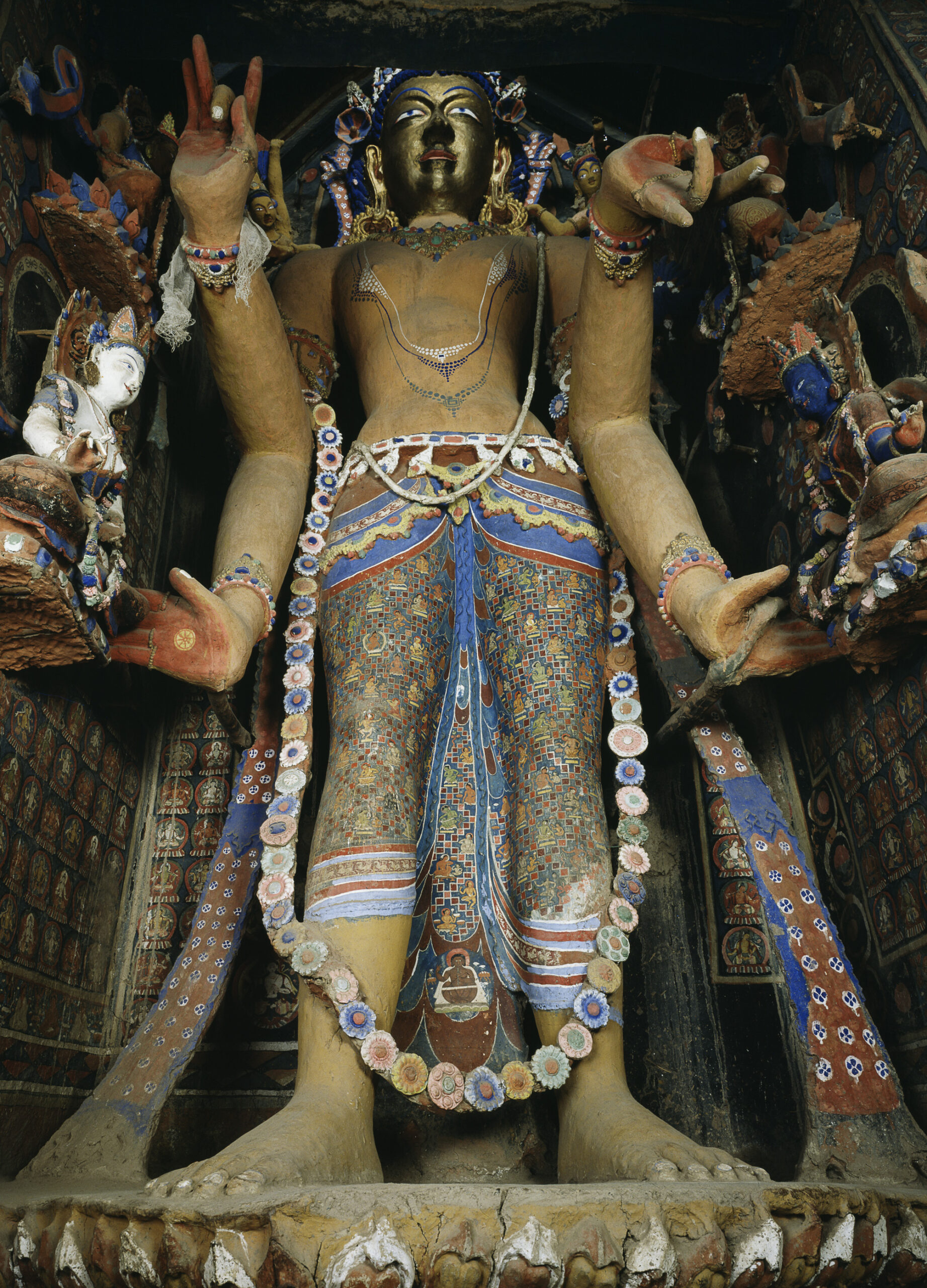
One of Alchi's greatest masterpieces is the monumental image of Avalokiteshvara, known in Tibetan Buddhism as Chenrezig.
Avalokiteshvara represents universal compassion. The large clay sculpture rises through the temple interior and is surrounded by painted decoration. Its garments contain numerous miniature sacred figures and detailed scenes.
The scale of the sculpture, combined with the refinement of its painted surface, demonstrates the advanced technical knowledge of Alchi's artists.
Main Temples of the Alchi Complex
Sumtsek
The Sumtsek is Alchi's most celebrated structure. Its name refers to a three-storey building. It contains monumental clay sculptures and some of the complex's finest wall paintings.
Dukhang
The Dukhang, or assembly hall, contains paintings, mandalas and sacred images connected with Buddhist teaching and ceremonial practice.
Manjushri Temple
This temple is dedicated to Manjushri, the Bodhisattva associated with wisdom, knowledge and spiritual insight.
Lotsawa Temple
The Lotsawa Temple honours the tradition of the great translator Rinchen Zangpo and the Buddhist revival associated with his work.
Chortens
The complex also includes historic chortens containing religious paintings, sacred symbolism and architectural decoration.
Temple Courtyard
The quiet courtyard connects the main religious buildings and reflects Alchi's intimate village setting beside the Indus River.
Alchi and UNESCO Significance
The Alchi complex is widely recognised as a monument of exceptional historical and artistic importance. Its temples preserve evidence of cultural exchange between several major regions of Asia.
The site is significant because it brings together religious ideas, architectural techniques and artistic traditions associated with India, Kashmir, Tibet and Central Asia.
Alchi has been discussed in relation to international heritage recognition, particularly because its paintings and sculptures represent a rare surviving record of medieval Himalayan Buddhist culture.
How Alchi Survived
Many ancient Buddhist monuments in Kashmir, Central Asia and the Himalayan region were damaged or destroyed by conflict, fire, environmental exposure, earthquakes and neglect.
Alchi's relatively isolated village location helped protect its temples. The buildings were also maintained by the local Buddhist community and are now administered in association with Likir Monastery.
However, the paintings remain extremely fragile. Moisture, dust, smoke, structural movement, artificial lighting and physical contact can all damage ancient pigments and wall surfaces.
How to Reach Alchi Monastery
Road Route from Leh
Alchi is located approximately 65 to 70 kilometres west of Leh, close to the Leh–Kargil highway. The road is generally paved and suitable for private cars, taxis and organised tour vehicles.
Driving time is usually around 1.5 to 2 hours, depending on traffic, road conditions and sightseeing stops.
After reaching Alchi village, visitors walk through the village lanes, orchards and traditional houses to reach the monastery complex.
Places to Combine with Alchi
Alchi can be visited as part of a full-day tour of the lower Indus Valley. Popular nearby attractions include:
- Magnetic Hill
- Sangam of the Indus and Zanskar Rivers
- Basgo Palace and Monastery
- Likir Monastery
- Hall of Fame in Leh
- Pathar Sahib Gurudwara
Best Time to Visit
The most comfortable period for visiting Alchi is generally from May to October, when road access is easier and daytime temperatures are milder.
- May and June: Pleasant weather and fresh spring scenery
- July and August: Warm days and the main travel season
- September: Clear skies and quieter travel conditions
- October: Cooler temperatures and beautiful autumn colours
Early morning or late afternoon visits can offer a quieter experience, although temple opening times should always be confirmed locally.
Visitor Etiquette and Conservation
Help Protect the Ancient Paintings
- Do not touch the paintings, walls or sculptures.
- Follow all photography restrictions inside the temples.
- Never use flash photography.
- Keep voices low inside prayer halls.
- Dress respectfully.
- Do not lean against painted walls or pillars.
- Follow instructions given by monks and temple caretakers.
Interesting Facts About Alchi
- Alchi contains some of the oldest surviving Buddhist wall paintings in Ladakh.
- The artistic style shows stronger Kashmiri and Indian influence than many later Ladakhi monasteries.
- The monastery is built on relatively flat land rather than on a hilltop.
- Its monumental clay sculptures rise through multi-level temple interiors.
- The paintings preserve details of medieval royal clothing and jewellery.
- Alchi is closely associated with the Buddhist revival linked to Rinchen Zangpo.
- The complex is presently connected administratively with Likir Monastery.
About this guide
Published by the Ladakh.com Editorial Team to help travelers understand Ladakh and plan more carefully. Conditions involving permits, roads, weather, altitude and local access can change, so reconfirm time-sensitive information before travel. About Ladakh.com