Ladakh Wildlife & Birdwatching: Snow Leopards, Cranes and Migratory Birds

This guide is published for trip planning and local understanding. Where permits, health, roads, weather or other changing conditions matter, reconfirm important details before travel. Learn about our editorial approach.
Ladakh.com Field Guide · Wildlife & Birdwatching
Ladakh Wildlife and Birdwatching: Snow Leopards, Black-Necked Cranes and the Wild Heart of the Himalaya
A locally minded field guide to Ladakh’s wild animals and birds—where to look, when to travel, how snow leopards use their mountain territory, which birds pass through on migration, and how to watch without disturbing the life that makes these landscapes special.
In Ladakh, a mountainside can appear empty for an hour and then come alive in a single moment. A herd of bharal picks its way along a cliff, a lammergeier rides a current of warm air, or a local tracker quietly points out the outline of a snow leopard where most of us would see only stone. At a high wetland, the scene changes: geese call across the water, waders move along the shore and a pair of black-necked cranes walks through the grass as if the wide plateau belongs to them alone.
These are not sightings that can be scheduled like museum visits. Ladakh’s wildlife follows snow, water, prey, breeding cycles and weather. The best wildlife journey leaves room for uncertainty. It rewards patience, a good local guide and the willingness to appreciate the whole landscape—not only the rare animal on a wish list.
We have put this guide together for curious travellers, photographers and birdwatchers who want to understand Ladakh’s wildlife as well as see it. We share the places and seasonal windows worth knowing, but we do not promise sightings. Our responsibility is to help people experience Ladakh thoughtfully, in a way that respects animals and the communities that live alongside them.
- Ladakh’s wildlife landscape
- Meet the snow leopard
- Behaviour and territory
- Where to look for snow leopards
- Best season and time of day
- How to spot one responsibly
- Other wild mammals
- Birdlife and migration
- Top birdwatching areas
- Black-necked cranes
- Wildlife calendar
- Planning and packing
- Responsible wildlife travel
- FAQs
1. The wild landscape of Ladakh
Ladakh is a high-altitude cold desert, but “desert” does not mean lifeless. Snowmelt feeds the Indus and its tributaries, small streams irrigate village fields, and remote wetlands hold water in an otherwise dry plateau. Rocky mountains, open steppe, scree slopes, river corridors and marshes sit close enough together that a change in habitat can bring a completely different set of species.
In the mountains around Leh, Hemis and the Sham region, the wildlife story is often about predators and their prey: snow leopard, bharal, Asiatic ibex, Ladakh urial, fox and wolf. Farther east, the wide spaces of Changthang support kiang, Tibetan gazelle in suitable areas, wolves, marmots and birds that breed at high-altitude lakes. Along the wetlands, waterbirds gather to feed, raise young or rest during seasonal movements.
This is also a landscape where wildlife and people have always shared space. Changpa pastoralists graze livestock across the plateau; villages manage water and fields in narrow valleys; dogs, roads and development can affect wild animals and birds. Conservation is therefore not simply about keeping people out. It involves healthy habitats, practical ways to reduce livestock losses, local knowledge, scientific monitoring and tourism that creates a reason to protect the landscape.
India’s first nationwide Snow Leopard Population Assessment estimated 477 snow leopards in Ladakh, within a national estimate of 718. The assessment used systematic surveys and camera-trap methods across the species’ Indian range. These are population estimates, not a count of animals available to be seen by visitors. Read the Government of India’s assessment summary.
2. The snow leopard: the ghost of the high mountains
The snow leopard (Panthera uncia) has a pale grey coat marked with dark rosettes, broad paws that work like snowshoes, dense fur and an exceptionally long tail. Its markings break up its outline among rock, shadow and patchy snow. Even through binoculars, a resting cat can be almost impossible to distinguish from the slope around it.
Snow leopards inhabit rugged mountain country across Central and South Asia. In Ladakh, suitable habitat includes broken ridges, steep gullies, cliff systems and rocky slopes where prey can feed and the cat can approach unseen. The animal is adapted to cold, thin air and difficult terrain; its powerful hind legs can propel it across gaps, while its long tail helps with balance and can wrap around the body in cold weather.
What does a snow leopard eat?
Important wild prey in Ladakh includes bharal (blue sheep) and Asiatic ibex. Depending on the local ecosystem, snow leopards may also take other wild ungulates and smaller mammals. Livestock can sometimes become prey, particularly where herds are vulnerable or natural prey is scarce. This is one reason conservation must include herding families and local solutions to reduce losses—not only the cat itself. For a general overview of snow leopard ecology, visit the Snow Leopard Trust’s guide to prey.
How does the snow leopard behave?
- Mostly solitary: adults usually travel alone except when a female is raising cubs or adults meet around breeding.
- Cryptic rather than confrontational: camouflage and distance are its first advantages. It is a wild predator, not an animal to approach or corner.
- An ambush hunter: it uses rock ledges, gullies and terrain to get close to prey before a powerful attack.
- Often active at low light: dawn and dusk can be productive periods, but snow leopards may move or feed by day as well.
- Communicates through scent and sign: scrapes, scent marks and repeated routes help leave information for other cats.
- Uses its range flexibly: the animal’s movements change with prey, season, breeding and human activity.
Snow leopards do not roar like lions. They can chuff, growl, yowl and make other vocalisations, but in the field a visitor is much more likely to learn about a cat through signs, tracks and the experienced reading of a slope than by hearing it.
3. Snow leopard territory: how much land does one cat use?
When wildlife researchers talk about a snow leopard’s home range, they mean the area it regularly uses for hunting, travelling, resting and finding mates. It is not a neat fenced territory with an exact border. Ranges can overlap, especially between males and females, while scent marking helps communicate which animals have been through an area.
Home ranges differ greatly with terrain and the availability of prey. In productive habitat an animal may use a more compact range; in an area where prey is scattered, it may need an enormous landscape to find enough food. Snow Leopard Trust materials describe ranges from a few dozen square kilometres to more than 1,000 square kilometres in some settings. These are examples from different study areas, not a single fixed measurement for every Ladakh cat. Read more about habitat and home ranges.
This explains why a snow leopard cannot be treated like a viewpoint attraction. The animal may travel across ridges that look close together on a map but require hours to reach on foot. Skilled trackers consider prey movement, fresh sign, terrain, weather and previous observations. Even then, no guide can responsibly guarantee a sighting.
4. Where to look for snow leopards in Ladakh
Hemis National Park and Rumbak Valley
Rumbak is one of Ladakh’s best-known winter tracking areas. It combines rugged slopes, rocky ridgelines and local knowledge built over years of observing wildlife. Trips often involve walking from the Zingchen side and staying in the wider area, depending on access and arrangements.
Ulley and the Sham region
West of Leh, the Ulley area and nearby high valleys are also associated with snow leopard tracking. A locally based tracker can advise which slopes are worth scanning and whether recent signs support spending time there.
Hemis Shukpachan and nearby valleys
The broader Sham landscape contains rocky habitat and winter wildlife areas. Conditions are highly local: one valley may have recent signs while a nearby one does not. Plan from current advice rather than a fixed promise.
Wanla Village and the Guphuks Gorges
Wanla, in western Ladakh, deserves a place in the wider conversation about snow leopard habitat. Its deep gorges and rugged slopes are part of a landscape shaped by generations of local observation. Family accounts describe snow leopards moving through the area while following wild prey. Wanla should be explored with knowledgeable local guidance—not treated as a guaranteed sighting point.
Wider eastern Ladakh
Snow leopards live beyond the handful of sites familiar to visitors. Parts of eastern Ladakh are remote or subject to sensitive border-area restrictions, so access should only be planned with current official and local guidance.
A personal story from Wanla: memories of the Guphuks
There is another place in western Ladakh that deserves to be part of the snow leopard story: Wanla, the village where I spent much of my childhood. My connection to these mountains is not only geographical. It comes from the stories my grandfather passed down—stories from a time when hunting was more common in village life and people knew the surrounding valleys through long days and nights spent out on the land.
My grandfather was remembered as a skilled hunter. He would spend extended stretches in the deep ravines known locally as the Wanla Guphuks, watching for Shapo (Ladakh urial) and Napo (blue sheep). In those rugged gorges, he sometimes encountered snow leopards moving through the same terrain, apparently searching for prey that might be easier to catch. The stories have stayed with me because they reveal how closely earlier generations watched the mountains—and how much wildlife knowledge can live in a family’s memory.
These recollections are not a scientific survey or a promise of present-day sightings. They are a piece of Wanla’s local history, offered alongside modern conservation knowledge. Today, any visit should be about observing wildlife from a respectful distance, with local guidance and without disturbing animals or pursuing them into the gorges. Wanla may be less frequently mentioned than some established tracking areas, but its landscape and local memories deserve to be heard.
The Leh district administration’s Hemis National Park page lists some of the park’s wider wildlife. When choosing a tour, ask whether the person leading the trip has specific experience with snow leopard tracking, spotting scopes, winter safety and ethical viewing—not only general sightseeing.
To plan with local providers, explore Ladakh.com’s local guide directory and travel-agent directory. Confirm that these site paths are active in your current website setup before publishing if your backend uses different URLs.
5. Which month and time of day is best for snow leopard spotting?
December through March is the usual winter season for dedicated snow leopard tracking in Ladakh. January, February and March are often popular with wildlife travellers. In winter, prey can move to different elevations and pale slopes may make a cat easier to distinguish. The breeding season also overlaps with winter, which can bring changes in movement and scent-marking activity.
| Month | What to expect | Planning advice |
|---|---|---|
| December | Winter tracking begins; conditions vary by valley. | Check road access, lodging and recent local observations. |
| January–February | Often strong months for dedicated tracking, with severe cold and snow possible. | Allow multiple field days, warm layers and a flexible schedule. |
| March | Tracking can remain productive, but spring conditions may begin to change access. | Confirm snow conditions and avoid assuming every route is open. |
| April–November | Snow leopards remain in the ecosystem, but casual sightings can be less predictable in many areas. | Consider a broader wildlife and birding itinerary instead of planning around a single cat. |
The best time of day
Begin scanning around first light and again in the late afternoon. Snow leopards are often active around dawn and dusk, and low-angle light can help reveal the folds and shadows of a mountain slope. If a cat is already visible or fresh signs suggest activity, a tracker may recommend continuing to watch at another time of day. There is no universal hour that guarantees success.
How many days should you allow?
If the snow leopard is the main purpose of your trip, plan several consecutive tracking days, plus time to acclimatise in Leh before exertion and a buffer for weather or travel disruption. Five to eight days in the wider region can be a useful starting framework, not a formula for a sighting. Some visitors find a cat early; others leave without one despite excellent field effort.
6. How to spot a snow leopard—without disturbing it
The most useful skill is learning how to read a mountain rather than searching for a clearly outlined animal. A good tracker will often scan the terrain in a pattern, checking likely ledges, gullies and ridges. Visitors using binoculars may initially see nothing; then a guide finds a pale shape under an overhang that turns out to be a resting cat.
- Choose an experienced local tracker. Ask about area-specific experience, available optics, group size and how they keep a responsible distance.
- Use binoculars or a spotting scope. A snow leopard seen from a suitable distance may look very small. Scan in sections rather than swinging the binoculars randomly.
- Notice the prey. Bharal and ibex are important prey animals. Their presence can make a slope ecologically interesting, though it does not mean a snow leopard is present.
- Let the guide read signs. Tracks, scrapes and scent marks may indicate recent use. Never follow tracks alone into remote terrain or approach a suspected kill, den or cub.
- Stay quiet and still. Avoid sudden movements, shouting or repeatedly changing position for a photograph. Follow the guide’s directions.
- Be patient with imperfect views. The first sighting may be a small shape lying among rocks or moving behind a ridge. A distant observation is still a real encounter.
- Accept a no-sighting day. Do not pressure a guide to chase an animal or take a risky route. The landscape, prey and tracks are part of the experience.
A camera with a long lens can help, but binoculars and a spotting scope are often more useful for finding an animal. Never use bait, call playback, drones or any technique intended to make wildlife move for the camera.
7. Other mammals: the wildlife beyond the famous cat
- Asiatic ibex: a powerful wild goat often seen on steep rocky faces. Males have long curved horns; herds can be easier to spot than predators.
- Bharal or blue sheep: a key prey species for snow leopards. Their grey-blue coat blends into stone, and groups often graze on open slopes with steep escape terrain nearby.
- Ladakh urial (shapu): a wild sheep associated with parts of the Indus and western Ladakh landscape.
- Kiang, or Tibetan wild ass: a striking animal of Changthang. Herds move across open plateau, where observing from a distance is better than following them with vehicles.
- Himalayan marmot: most readily seen in warmer months. They stand upright to scan for danger and can give sharp alarm calls. Never feed them.
- Tibetan wolf and red fox: both form part of the wider ecosystem, though sightings are unpredictable. Foxes may be seen around open country and the edges of settlements.
- Tibetan argali and Tibetan gazelle: these high-plateau ungulates occur in particular landscapes and may take patient searching and local knowledge to find.
- Pika, hare and smaller mammals: easy to overlook, but important to the food web and the survival of raptors and other predators.
Hemis National Park is a particularly rich area for mountain wildlife. The official district page describes snow leopard, bharal, ibex, dhole, Tibetan wolf, red fox, marmots and other mammals found in the region.
8. Birdwatching in Ladakh: an unexpected world
Ladakh’s birds are part of two very different scenes. In the mountains and open steppe, raptors, snowcocks, choughs, accentors and finches live among rock and scrub. At lakes and marshes, geese, ducks, gulls, grebes, terns and waders gather to breed, feed or rest during migration. Village orchards, streams and willow stands add yet another group of birds.
Ladakh lies within the wider Central Asian Flyway, one of the major migration routes linking breeding and non-breeding areas across Asia. High-altitude wetlands are especially valuable because suitable water and food are scarce across the surrounding cold desert. The Tso Kar Wetland Complex, designated a Ramsar Wetland of International Importance in 2020, is a key stopover site for migratory birds and an important breeding area for black-necked cranes. The Government of India’s Wetlands of India portal lists 139 bird species for the Tso Kar wetland complex and identifies important species and habitat values.
Birds of the high mountains and rocky slopes
Watch for golden eagle, lammergeier (bearded vulture), Himalayan griffon, upland buzzard, saker falcon, Tibetan snowcock, chukar, red-billed chough, Tibetan snowfinch, accentors and rosefinches. Some species soar high overhead; others stay low and disappear into stones. The official Hemis National Park guide lists a number of these mountain birds.
Waterbirds and wetland species
Depending on the lake, year and season, visitors may see black-necked crane, bar-headed goose, ruddy shelduck, greylag goose, great crested grebe, brown-headed gull, common tern, redshanks, sandpipers and sand plovers. Some are summer breeders, while others occur during migration or at particular sites only. The exact mix changes from one wetland and season to another.
Which birds stop in Ladakh during migration?
Waterbirds and waders use Ladakh’s lakes and marshes as seasonal resting and feeding grounds. Passage migrants may include ducks such as northern pintail, northern shoveler and Eurasian wigeon, along with shorebirds such as sandpipers, redshanks, sand plovers and stints, depending on the wetland and date. Bar-headed geese are famous for high-altitude Himalayan crossings, but they also breed in Ladakh, so a summer bird is not necessarily just passing through.
Autumn passage at Tso Kar can be impressive: regional wetland information notes that birds gather there before continuing their journeys, at times in large numbers. Migratory schedules vary with weather, water levels and breeding success. A bird list should therefore be treated as a guide to possibilities, not a guarantee for a certain day.
9. Best places for birdwatching in Ladakh
Tso Kar and Startsapuk Tso
Tso Kar is a saline lake, while nearby Startsapuk Tso is freshwater. Together they form the Tso Kar Wetland Complex in Changthang at over 4,500 metres. Freshwater edges, marshes and the saline lake margins create complementary habitats. The complex is internationally important for migratory birds and breeding black-necked cranes, as well as species such as great crested grebe, bar-headed goose, ruddy shelduck and brown-headed gull. Read the official wetland profile.
Tso Moriri and Korzok
Tso Moriri is a high-altitude lake in southeastern Ladakh with open water, shore habitat and surrounding grassland. Depending on conditions, birds may include black-necked cranes, bar-headed geese, ruddy shelducks, grebes, gulls and other waterbirds. The wider plateau also supports kiang and other mammals. At roughly 4,500 metres, it is essential to acclimatise properly and keep walks gentle when arriving.
For practical destination details, read Ladakh.com’s Tso Moriri guide.
Hanle, Chushul and the wider Changthang Plateau
Changthang is a network of wetlands, seasonal streams, grasslands and open steppe—not one single viewing point. The Hanle and Chushul areas and nearby wetlands can support cranes, geese, waders and mountain birds. Access to some eastern areas is sensitive and rules may change; confirm current permissions and restrictions before travelling. Use local advice and do not approach nesting sites.
Pangong Lake
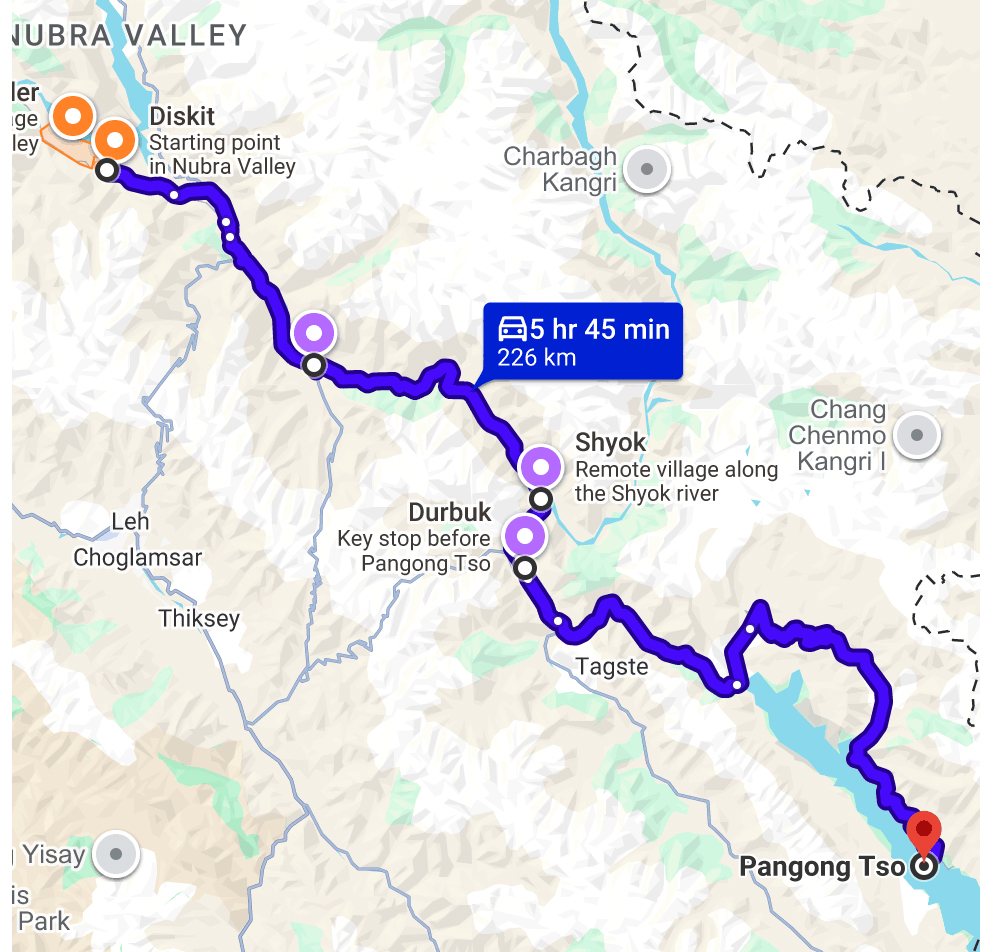
Pangong’s shores and surrounding wetlands can also offer bird observations. Species and numbers vary, and exposed high-altitude conditions require care. Do not walk straight towards birds for a closer image or drive off established routes to reach a shoreline.
Indus Valley and village habitats
You do not need to travel to the most remote plateau to begin birding. Along the Indus, in village gardens, orchards, stream corridors and willow stands, watch for wagtails, redstarts, warblers, swallows, swifts, hoopoes and finches, particularly in the warmer months and migration periods. These accessible habitats are a gentle introduction for new birdwatchers.
10. Black-necked cranes: Ladakh’s special summer visitor
The black-necked crane (Grus nigricollis) is one of Ladakh’s most cherished birds and the region’s state bird. It has a pale grey body, black neck and head, a red crown and long legs made for walking through shallow wetlands. In the immense openness of Changthang, a pair may look small against the mountains; their calls, however, can carry a long way across a still morning.
For many travellers, seeing these cranes is a highlight of summer in Ladakh. For the birds, the shallow pools and wet meadows are nesting and feeding habitat. The difference matters: a visitor sees a beautiful scene, while a crane pair is trying to raise young in a short, cold summer.
When do black-necked cranes arrive?
A long-term study of 147 pairs in Changthang found that cranes arrived at breeding grounds from the last week of March to the first half of April. Egg-laying began in May and continued into July in the study period; most clutches contained two eggs and the reported incubation period averaged about 34 days. These are long-term study results, not fixed dates for every year. Read the breeding ecology study in the Journal of the Bombay Natural History Society.
In practical terms, late spring and summer are the main window for cranes in Ladakh. April may bring pairs back to their breeding wetlands, while May, June and July can bring courtship, nesting and family activity. Timing varies with weather and conditions at the site.
Where can you see black-necked cranes?
Look in suitable wetlands across Changthang, including the wider Tso Kar, Tso Moriri, Hanle and Chushul landscapes. Local guides can advise which locations are appropriate at the time of your trip. The cranes move between nesting, feeding and roosting areas; there is no guarantee that birds seen one day will be at the same wetland the next.
How do black-necked cranes behave?
Pairs may walk side by side, call to one another, bow, raise their wings and perform short leaps during courtship. They feed on plant material—including roots and tubers—and small animals such as insects. During nesting, a pair needs quiet around its nest and safe access to feeding grounds. Adults may become more cautious when chicks are young, and what looks like an ordinary stretch of wet meadow may contain a nest hidden from the road.
Conservation research in Ladakh has drawn attention to disturbance, wetland changes and free-ranging dogs as pressures on breeding birds. These challenges are best addressed through well-managed habitat, community partnership, responsible tourism and appropriate local management—not by blaming one group of people.
Where do they go in winter?
Black-necked cranes are summer breeders in Ladakh. As the high plateau freezes, birds leave the breeding wetlands for lower-altitude wintering areas. Different populations use different routes: wintering areas for the species include parts of the Tibetan Plateau and southern Tibet, as well as Bhutan and other regions. It would be misleading to say that every crane in Ladakh follows the same route. The broad local pattern is that cranes return in spring, breed during the short summer and depart as autumn conditions worsen. For wider context, see BirdLife International’s article on black-necked crane habitat and this research on satellite-tracked migration routes.
11. Wildlife calendar: which season should you choose?
| Period | Wildlife focus | What to know |
|---|---|---|
| January–February | Dedicated snow leopard tracking; bharal, ibex and mountain wildlife. | Very cold and potentially difficult; use experienced local support and allow flexibility. |
| March | Late-winter tracking; early seasonal change; crane arrivals may begin late in the month. | Roads and trails can vary with snow and thaw. |
| April | Returning cranes and spring waterbirds. | High roads and some facilities may still be affected by winter. |
| May–June | Active wetland birding, crane breeding season, mountain birds and wildlife in longer daylight. | Often a rewarding all-round period, subject to access and altitude precautions. |
| July | Crane nesting and chick season; summer birds are active. | Be particularly careful around wet meadows and breeding habitat. |
| August–September | Broad birding opportunities, young birds and autumn movements beginning at some wetlands. | Good time for a wider wildlife-and-birding itinerary; conditions can still change quickly. |
| October–November | Autumn passage; transition towards winter. | Prepare for cold and check facilities and access before remote journeys. |
| December | Winter tracking season opens in many snow leopard areas. | Weather may affect routes; build spare time into plans. |
These are general seasonal windows, not a live sightings bulletin. Weather, snow, wetland levels and animal movements vary from year to year.
12. Planning and packing for a wildlife trip
For winter snow leopard tracking
- Insulated layers, windproof outerwear, warm hat and gloves.
- Sturdy boots with grip and warm socks; spare dry layers.
- Binoculars; ask whether the guide provides a spotting scope.
- Water, snacks, sun protection and a headlamp.
- Personal medication and a clear plan for altitude symptoms.
For birdwatching
- Binoculars; a spotting scope is useful at distant wetlands.
- A bird field guide or offline identification app and a notebook.
- Warm, wind-resistant layers and footwear for gravel or damp ground.
- Telephoto lens if you photograph birds, while maintaining distance.
- Reusable water bottle and a bag for every piece of rubbish.
Plan fewer stops and more time at each one. Early mornings are rewarding for birding, while late-afternoon light can be beautiful for scanning mountain slopes. Keep spare time for weather and road changes, and never assume that mobile service, fuel or medical help will be readily available in remote areas.
Before travelling, use our general Ladakh guide for broader trip planning, the Tso Moriri guide for destination context, and the local guide directory or travel agent directory to start speaking with local providers. Please verify internal URLs in the live site backend before publishing.
13. Responsible wildlife watching: the Ladakh.com promise
Wildlife tourism can help support local households and give communities a stronger reason to protect habitat. But that benefit only lasts when animals are allowed to behave naturally. Keep a generous distance, avoid pressure on nesting areas, and do not treat wild animals as attractions that owe a visitor a close-up.
- Never chase wildlife by vehicle or surround an animal with a group of cars.
- No feeding, baiting, drone flights or playback. These can change behaviour, cause stress and reveal sensitive sites.
- Stay on existing tracks. Driving over wetlands or fragile grassland damages the habitat that birds and wild mammals rely on.
- Do not approach nests, dens, cubs or kill sites. If you suspect a nest, quietly move away and do not post its coordinates.
- Choose responsible local guides. Ask how they avoid disturbance and what they do when wildlife is too close to a route.
- Leave nothing behind. Pack out plastics, tissues, food scraps and batteries; do not contaminate streams and lakes.
- Respect local people and sensitive areas. Ask before taking portraits and follow current restrictions in border regions and protected areas.
Conservation has to work for people as well as wildlife. The households who live with predators, livestock losses, short summers and limited services need to be partners in decisions and benefit fairly from tourism. When you choose local guides, guesthouses and community-run experiences, you help connect responsible travel with livelihoods on the ground.
14. Frequently asked questions
What is the best month to see a snow leopard in Ladakh?
December to March is the standard winter tracking window. January to March is popular with dedicated trackers, but weather and sightings vary; there is no guaranteed month.
What time of day should I look for a snow leopard?
First light and late afternoon are useful periods because snow leopards are often active around dawn and dusk. A local tracker may change the schedule based on recent signs, weather and visibility.
Where do visitors look for snow leopards?
Rumbak in Hemis National Park, Ulley and the wider Sham region are established tracking areas. Use current local advice rather than relying on fixed online sighting promises.
When can I see black-necked cranes in Ladakh?
They generally return to Changthang breeding grounds from late March into early April and remain during the summer breeding period. May to July can include nesting activity, so maintain a generous distance.
Where are the best places for birdwatching?
Tso Kar and Startsapuk Tso, Tso Moriri, Hanle and the wider Changthang wetlands are important areas. Indus Valley streams and village gardens can also be rewarding and more accessible.
Which migratory birds stop in Ladakh?
Depending on season and site, migrants can include ducks, geese, gulls, waders, sandpipers, redshanks and sand plovers. Bar-headed geese also breed in Ladakh, so not every summer waterbird is just passing through.
Can I guarantee a snow leopard sighting on a tour?
No responsible operator can guarantee a wild animal sighting. Several tracking days and an experienced guide can improve the opportunity, but nature remains unpredictable.
Is winter wildlife travel safe?
It requires proper acclimatisation, warm equipment, local expertise and flexible planning. Severe cold, altitude, snow and limited facilities all matter. Follow medical and local safety advice.
📸 Take Photographs, Leave Only Footprints.
Respect culture. Avoid litter. Conserve water. Support local people.
Planning a photography expedition or a winter snow leopard spotting trip to Ladakh from the USA?
For expert guidance, personalized arrangements, and a well-planned itinerary to make the most of your wildlife photography adventure, contact Nawang Namgil, a nature photographer based in Minnesota, USA. 📞 Call: 651-408-4371 Let’s plan an unforgettable winter wildlife adventure in Ladakh!